OCTO participates to “AUTONOMY Paris“ at Porte de Versailles, Pavilion 6, on the 16th and 17th of March.
Autonomy Paris was the first trade show dedicated to new sustainable mobility solutions and has quickly become the world’s most important annual event B2B (Business to Business) and B2G (Business to Government).
Two days to discover the latest industry trends and news, meet new suppliers and partners and attend expert featuring conferences.
OCTO’s Olga Stepanova is attending Autonomy Paris. Do not miss the opportunity to join us!
Researchers Erik Karger, Marvin Jagals, and Frederik Ahlemann from the University of Duisburg-Essen, Essen, Germany, published an article in Sustainability on November 30, 2021, regarding blockchain for smart mobility. The article provides an a-up to date review on this issue. Here there are some of the key issues.
Today’s cities face numerous challenges due to climate change and urbanization. The concept of a smart city aims to help cities to address these challenges by adapting modern information and communication technology. Smart mobility and transportation form one important aspect of smart cities. Inefficient mobility in cities can lead to problems such as traffic congestion, which results in frustration for residents and a decrease in the quality of life. The major environmental and global warming impact of cities makes it necessary to act in environmentally friendly and sustainable ways. The concept of transforming urban areas into so-called smart cities arose to address the fundamental economic and ecological issues of the 21st century. Smart mobility aims to assist cities in reducing traffic, accident rates, and urban footprint. Furthermore, smart mobility concepts can help to improve air quality and thus assist cities in achieving sustainable growth, since mobility and transportation are major drivers of climate change.
New technologies like blockchain are developing rapidly. Research on smart cities and blockchain already pointed out the enormous potential of blockchain in the context of smart mobility. The study underlines that due to the blockchain’s decentralization, transparency, and immutability it is a fitting technology for deploying a decentralized trust management system in automotive networks.
Additionally, the authors stress that the blockchain has the potential to enable decentralized intelligent transportation systems and decentralized vehicular applications. The use-cases dealing with blockchain in the context of smart mobilities can be divided into five categories.
1 – Intelligent Transportation Systems
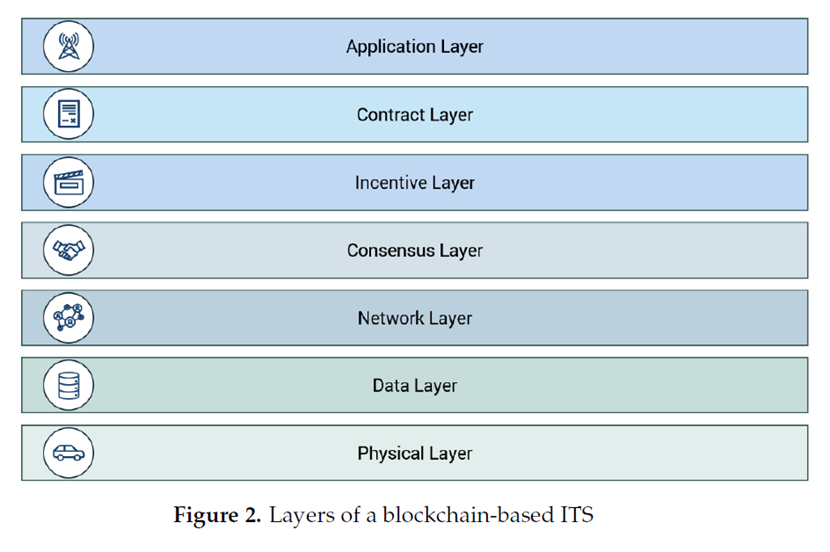
Intelligent transportation systems (ITS) have emerged with the goal to apply several advantages to mobility, like improving travel security and increasing the performance of transportation systems. In addition, ITS enables smart vehicles to communicate with each other and access the internet. Some authors take a broader perspective and propose a blockchain-based ITS model. They believe that the advantages of blockchain models like decentralization, security, and trust make it highly suitable for such a purpose.
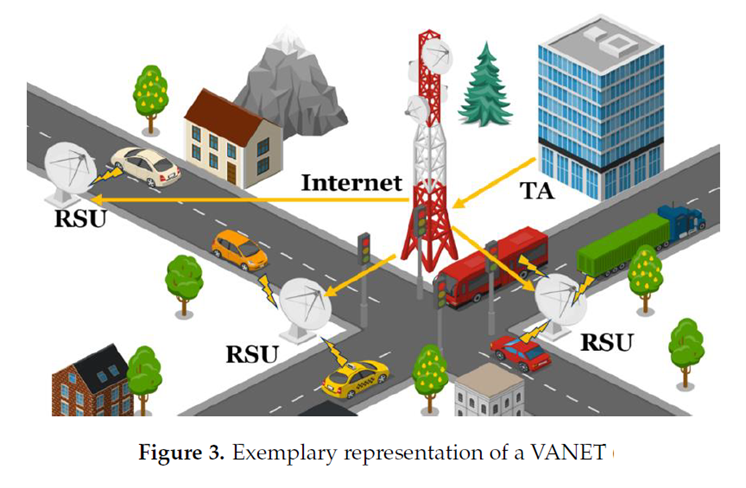
Vehicular networks, also referred to as vehicular ad-hoc networks (VANETs), are a component of an ITS and can be defined as a self-organized network in that vehicles can communicate with each other (vehicle-to-vehicle, V2V) and with the infrastructure (vehicle to-Infrastructure, V2I). Such a VANET allows vehicles to share information about weather conditions or road defects, for example, thus increasing the security and efficiency of the traffic. With wireless communication devices on-board units (OBUs), the autonomous vehicles can communicate with each other and road side units (RSUs). A trusted authority (TA) is another component responsible for managing the whole system. However, to guarantee secure communication, several issues concerning privacy and security need to be addressed. Security in VANETs is crucial, as attacks might directly involve or endanger human lives. Here, for example, blockchain can help users obtain the trust values of other participants and received messages, or enable secure key management between different vehicles.
2 – Vehicular Communication
Next to the fundamental architecture of VANETs and ITSs, vehicular communication is another aspect in the context of smart mobility where the blockchain might be able to bring improvement. Some authors argue that, despite developments over the last years, VCSs still have to deal with problems and issues concerning security and key management. Therefore, these authors propose a blockchain-based key-management scheme to share the keys for communication between different devices or vehicles securely.
With the help of the blockchain-based approach, network participants can obtain the trust values of other participants in the network and, based on this, evaluate the trustworthiness of received messages.
3- Electric Charging
A blockchain in combination with smart contracts could be a good technology to avoid the involvement of a third party and, thus, to create the autonomy and dynamism of the approach. The study points out a solution called PETCON, which makes it possible for Plug-in Hybrid Electric Vehicles (PHEVs) to buy and sell energy from and to each other in smart grids. This enables the charging and discharging of PHEVs by simultaneously ensuring security and transparency without the need for a trusted third party.
4 – Ridesharing
Blockchain promises multiple advantages and benefits for ridesharing. Increased security is one that is mentioned most often. Security is a broad term and has many different meanings in the context of ridesharing. In most cases, though, it means security against malicious drivers and riders.
In the context of ridesharing blockchain is supposed to solve different security-related problems. Furthermore, vehicles participating in ridesharing platforms must share private in formation which is stored in a centralized and controlling instance. This centralization presents the issue of possible data leakages that threaten individual privacy. The researchers indicate that due to its decentralized nature, blockchain may be a possible answer to these security issues, since it avoids a single point of failure.
5 – Platooning
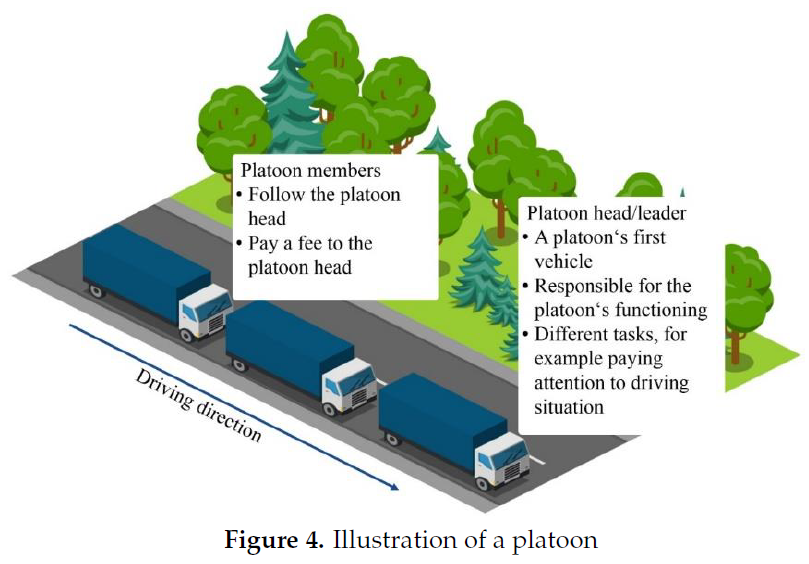
Finally, there are use-cases utilizing blockchain in the context of truck platooning. A truck platoon can be defined as a group of self-driving trucks moving together in a convoy. Truck platooning presents many advantages, including cost savings due to reduced fuel consumption, and the resultant reduced emissions. In addition, truck platoons enable more efficient use of the infrastructure by taking up less road space, which reduces the risk of traffic congestion, and increases possible traffic. Future research should address the question of which consensus algorithm is most suitable for a blockchain in the platooning context.
Malicious vehicles that can compromise the security of a platoon post a major threat to platoon configurations. This can happen, for example, through targeted cyberattacks or denial and misappropriation of payments. The study emphasises that the blockchain can help to increase the security of platoons in various ways, for instance, by allowing vehicles to validate each other’s integrity or by using smart contracts that force malicious platoon members to pay a fee. Even though blockchain is supposed to promise more security for mobility, it can also contribute to new security problems. As mentioned in the previous section, faulty smart contracts, especially, can lead to serious security issues. Thus, for blockchains to be effective in increasing security and not lead to new problems, the issue of security must also play an important role in the development of blockchain solutions for smart mobility.
Conclusions
Due to the increasing urban population, today’s cities are confronted with several challenges. Smart cities try to find new solutions for today’s challenges caused by urbanization and environmental change. Mobility and transportation form one crucial aspect of today’s cities. Efficient and sustainable mobility is a precondition to avoid problems like traffic congestion, to ensure a high quality of life for a city’s residents and tourists, and to reduce carbon emissions and environmental pollution.
The use of blockchain for smart mobility use-cases has already been addressed by research. However, despite the initial work in this area, the research is still fragmented and sometimes barely sufficiently integrated. With this review, the authors aim at closing this gap and providing an overview of the current state of the art in blockchain for smart mobility. They did so by categorizing the applications of blockchain for smart mobility into five different use-cases.
This can serve as a foundation for future research endeavors within this promising and emerging field. The researchers assumed that there will be a variety of future developments in the field of blockchain.
OCTO participates in the NADA Show 2022 takes place in Las Vegas Thursday, March 10, through Sunday, March 13.
The NADA Expo is the auto industry’s premier marketplace of innovations and solutions where attendees can search and shop thousands of products and services from the industry’s top vendors and suppliers — spanning from brand new start-ups to established Fortune 500 companies.
Do not miss the opportunity to join us at theNADA Show 2022!
Aggressive driving is a factor in 54% of all fatal motor vehicle crashes, according to the AAA Foundation for Traffic Safety. To shed light on this rapidly growing issue, we compiled the latest statistics and facts about road rage in the U.S.
Most drivers in the U.S. will come in contact with dangerous drivers. Road rage, commonly characterized by aggressive driving, is a factor in more than 50% of all car crashes that end in fatality, according to the AAA. In fact, in a separate years-long study, road rage episodes resulted in about 30 deaths and 1,800 injuries per year.
In this article:
• What is road rage? • Road rage behaviors • Road rage statistics • Road rage accidents and deaths • How common is road rage? • Road rage statistics by state • Road rage risk factors • Is your commute contributing to road rage? • Road rage driving laws state by state • How road rage impacts car insurance rates • How to prevent road rage • What to do in a road rage situation
What is road rage?
Road rage occurs when a driver experiences extreme aggression or anger intending to create or cause physical harm.
The term road rage dates back to the 1990s when the media dubbed a new term for the growing trend of extreme aggressive driving cases that seemed to be flooding the country. Many legislators have made it a criminal offense to express the severity of road rage, while aggressive driving remains a traffic violation in most areas.
Road rage behaviors
It is important to note that aggressive driving and road rage are not the same, although aggressive driving contributes to road rage. According to the NHTSA, aggressive drivinng is when “an individual commits a It is important to note that aggressive driving and road rage are not the same, although aggressive driving contributes to road rage. According to the NHTSA, aggressive driving is when “an individual commits a combination of moving traffic offenses so as to endanger other persons or property.”
Road rage takes things one step further into more violent and potentially dangerous territory.
Aggressive Driving vs. Road Rage
Aggressive Driving
Road Rage
Basic definition
Deliberate, unsafe driving behavior that poses a risk to property or another
Extreme deliberate, unsafe driving that poses an immediate and significant risk to property or another
Common behaviors
Tailgating Speeding when in heavy traffic Cutting off another driver Running red lights Weaving in and out traffic Frequently changing lanes
Rude or inflammatory gestures Profanity Hitting, bumping, sideswiping, or ramming another vehicle Use of headlights or brakes to intimidate or harass other drivers Forcing another car off the road
Road rage statistics
Aggressive driving and road rage can be difficult to quantify. They play roles in accidents but are not always the main reason for an injury or death. However, these statistics help give a better look into the hidden world of road rage.
78% of drivers report committing at least one aggressive driving behavior in the past year, including tailgating, yelling, or honking to show annoyance to another driver.(AAA)
The most common types of road rage are tailgating, yelling or honking at another vehicle, and are a factor in more than half of all fatal crashes.(AAA)
In a seven-year period, road rage incidents caused 218 murders and 12,610 injuries.(AAA)
That’s about 30 deaths and 1,800 injuries per year caused by road rage.(AAA)
Running late is one of the leading reasons given for aggressive driving, and the most frequently-cited excuse for following too quickly and passing on the right.(NHTSA)
Road rage accidents and deaths
78% of drivers report committing at least one aggressive driving behavior in the past year, including tailgating, yelling, or honking to show annoyance to another driver.(AAA)
The most common types of road rage are tailgating, yelling or honking at another vehicle, and are a factor in more than half of all fatal crashes.(AAA)
In a seven-year period, road rage incidents caused 218 murders and 12,610 injuries.(AAA)
That’s about 30 deaths and 1,800 injuries per year caused by road rage.(AAA)
Running late is one of the leading reasons given for aggressive driving, and the most frequently-cited excuse for following too quickly and passing on the right.(NHTSA)
Some leading factors show prevalence in road rage accidents.
Gender
Gender is a major contributing factor in most road rage cases, with males more likely to exhibit road rage than females. While around half of males and females were likely to tailgate another driver, more severe actions skew male. For example: cutting off another driver (15.5% of males, 8.3% of females), confronting them (5.7% of males, 1.8% of females), and bumping or ramming another car (4.3% of males, 1.3% of females).
Self-reported aggressive driving behaviors weighted %, male v. female
Male
Female
Tailgate
55.5%
46.1%
Yell
49.5%
43.7%
Honk
49.0%
39.9%
Gesture
40.0%
25.0%
Block from changing lanes
28.6%
19.8%
Cut off
15.5%
8.3%
Confront
5.7%
1.8%
Bump/ram
4.3%
1.3%
Source: AAA
Age
Age is another factor that seems to contribute to road rage. Drivers between the ages of 25 to 39 were the most likely to exhibit road rage behaviors, according to the AAA. People between 19 and 24 were most likely to prevent another driver from changing lanes or bump or ram another vehicle.
Self-reported aggressive driving behaviors weighted %, by age
16-18
19-24
25 – 39
40 – 59
60 – 74
75+
Tailgate
48.5%
45.5%
66.7%
51.2%
38.9%
35.6%
Yell
40.5%
51.8%
51.9%
50.2%
40.1%
24.1%
Honk
34.4%
43.5%
53.6%
46.7%
37.4%
26.6%
Gesture
26.2%
39.8%
42.8%
33.4%
23.2%
14.6%
Block from changing lanes
12%
28%
27.5%
26.3%
19.3%
17.9%
Cut off
9.2%
14.8%
16.8%
12.2%
7.3%
5%
Confront
2.1%
4.4%
6.2%
3.4%
2%
2.4%
Bump/ram
3.4%
4.4%
4.3%
2.5%
1%
2.8%
What makes road rage so dangerous is that about half of all road rage victims feel enraged by their experience, amplifying the issue. Worse, about two percent of road rage victims admit to wanting revenge.
How common is road rage?
In its survey, the NHTSA asks motorists about feelings of safety on U.S. roads. About 60% said their family feels threatened by unsafe driving, while three-quarters of respondents urged for something to be done.
The AAA Foundation for Traffic Safety did a deep dive into the behaviors seen on American roads. The results are staggering.
Almost 80% of all drivers affirmed that while driving, they had experienced extreme anger, aggression, or road rage within the last month alone.
About 78% of drivers admit to engaging in aggressive behavior themselves.
About half of drivers admit honking, yelling or purposely tailgating another vehicle as the most common expressions of annoyance and anger.
Likelihood of Aggressive Driving Among U.S. Drivers (AAA, 2019)
Behavior
Percentage of drivers
Total number of drivers
Aggressively switching lanes while close to another vehicle
26%
57 million
Honking or making rude gestures
32%
71 million
Driving 15 mph or more over the highway speed limit
48%
106 million
Running a red light
31%
68 million
Cutting in front of another vehicle
22%
49 million
Speeding to prevent another vehicle from passing you
25%
55 million
Tailgating to prevent another vehicle from merging in front of you
34%
75 million
Rushing to merge into traffic in front of another vehicle
28%
62 million
Worst states for road rage
Some states have significantly worse drivers than others.
While complete data for the number of road rage cases per state is not available, we looked at the Trace’s study on road rage with a firearm, and the statistics are alarming. Florida is the top-ranking state for road rage with a firearm from 2014 to 2016, with Texas, California, Tennessee, and Pennsylvania in close pursuit. Louisiana experienced 35 cases of road rage with a firearm in just three years from 2014 through 2016.
Road rage cases by state (2014-2016)
Rank
State
Number of road rage cases involving a firearm
1.
Florida
147
2.
Texas
126
3.
California
82
4.
Tennessee
68
5.
Pennsylvania
62
Within each state, certain cities and metropolises are more susceptible to road rage with firearms than others. Los Angeles, New York City, Miami, Phoenix, and Tampa are the leading cities for road rage with a gun based on 2014-2016 data.
Road rage risk factors
What circumstances make road rage more likely? While incidents can happen anywhere at any time, there are certain factors that increase risk:
Age: Studies show that younger drivers aged 19 and below are more than four times more likely to be involved in an aggressive driving crash than their older counterparts.
Month and day: Road rage incidents tend to be more likely in the summer months of July, August, September and even into October. They are also more likely towards the end of the week, based on the Auto Insurance Center’s analysis of Instagram posts using the #roadrage hashtag.
Time of day: The same social media study found that the use of the hashtag #roadrage was much higher between 4 p.m. and 7 p.m., coinciding with peak commute hours.
Type of car: Drivers with convertible tops up honked longer, sooner, and more often than those with their convertible tops down, according to the NHTSA.
Certain behaviors surface again and again in fatal accidents. Not so coincidentally, many of these behaviors also coincide with road rage. The NHTSA reports that many of the major contributing factors to all motor vehicle crashes include aggressive behaviors:
Speeding
Driving under the influence (DUI)
Following improperly
Improper or erratic lane changing
Illegal driving on the road shoulder, in a ditch, or on sidewalk or median
Passing where prohibited
Operating the vehicle in an erratic, reckless, careless, or negligent manner or suddenly changing speeds
Failure to yield right of way
Failure to obey traffic signs, traffic control devices, or traffic officers, failure to observe safety zone traffic laws
Failure to observe warnings or instructions on a vehicle displaying them
Failure to signal
Driving too fast for conditions or in excess of the posted speed limit
Racing
Is your commute contributing to road rage?
Road rage tends to affect those who spend a lot of time on the road, and that’s most often commuters. Again and again, traffic congestion is cited as a leading factor in aggressive driving incidents.
Commuter-reported factors in road rage and aggressive driving
Trigger factors
Percentage of drivers
Impatience while waiting at traffic lights or for parking
33%
Impatience waiting for passengers to enter their vehicle
25%
Anger when a multi-lane highway narrows
22%
Source: (NHTSA)
The NHTSA notes in its study that the rise in aggression and rage could be directly attributed to more drivers driving more miles with each passing year. There simply is not enough space to accommodate all of the drivers jamming America’s roads and highways.
Road rage driving laws state by state
Road rage remains largely ambiguous within the eyes of the law. Most states have not enacted legislation expressly addressing road rage. Instead, just a handful of states across the country have aggressive driving laws.
Texas offers a clea definition for its law, defining reckless driving as “a willful disregard for the safety of persons or property.” A misdemeanor, you could face fines up to $200 and a maximum of 30 days in jail if found guilty.
In Delaware, reckless driving can cost you up to $300 in fines and up to 10 days in jail. Virginia charges up to $2,500 in penalties, and in Oregon, penalties run as high as $6,250. Drivers found guilty of reckless driving in Washington could face as much as $5,000 and up to 364 days in jail.
Massachusetts has the Juvenile Operator Law, also known as State Courts Against Road Rage, which requires teen drivers and certain offenders to complete a SCARR or driver improvement course.
Pending reckless driving and road rage legislation
State
Pending
Failed
Arizona
AZ S 1533 Highway Obstruction/Drag racing AZ H 2296 Restricted Licenses/Aggressive driving
Colorado
CO H 1039 Careless Driving Serious Bodily Injury (Pending/postponed indefinitely)
Florida
FL S 1248 Racing Motor Vehicles FL H 1531 Local Law Enforcement Agencies
Georgia
GA S 10 Promoting Illegal Drag Racing Offense GA H 534 Illegal Drag Racing
Hawaii
HI S 377 Traffic Violations HI H 385 Reckless Driving
Maryland
MD S 17 – Life-Threatening Injury
MD H 178 – Reckless Driving Speed Contests MD S 337 – Excessive Speeding MD S 408 – Reckless Driving MD H 494 – Reckless Driving MD S 495 – Negligent Driving MD H 668 – Negligent Driving MD H 855 – Criminal Law Life-Threatening Injury Involving a Motor MD H 926 – Vehicle Homicide
Massachusetts
MA H 3389 – Engaging in High-Speed Chases
Michigan
MI H 4153 Suspended License Penalties/Aggressive Driving
Missouri
MO H 891 Offense of Aggravated Endangerment of a Highway Worker
Montana
MT D 385 Commercial Driver Serious Offense Laws/Aggressive Driving MT D 627 Traffic Safety Laws/Aggressive Driving
Nevada
NV A 116 Traffic Offenses and Violations/Aggressive Driving NV S 393 Traffic Offense Civil Penalties/Aggressive Driving
New Jersey
NJ S 713 Failure to Maintain Lane/Aggressive Driving NJ S 783 Vehicle Accident Lawsuit Option Limitation/Aggressive Driving NJ A 2716 Vehicular Homicide Minimum Term/Aggressive Driving NJ S 3050 Reckless Vehicular Homicide NJ A 3334 Aggressive Driving Offense
New Mexico
NM H 58 Additional Violent Felonies NM S 343 Crime of Racing on Highways or Streets
New York
NY S 717 Reckless Driving NY S 764 Traffic Violation Convictions NY A 1147 Reckless and Dangerous Driving NY A 3036 Reckless Driving NY S 3534 Vehicular Violence Accountability Act NY A 5188 New Crime of Aggressive Driving
Oklahoma
OK H 1770 Public Safety/Aggressive Driving
Rhode Island
RI S 596 Motor Vehicle Offenses/Aggressive Driving RI H 5094 Motor Vehicle Offenses/Aggressive Driving RI H 5574 Motor Vehicle Offenses/Aggressive Driving RI H 5630 Automobile Accident Social Protection Act/Aggressive Driving RI H 5631 Highway Safety Act/Aggressive Driving
South Carolina
SC S 135 Reckless Vehicular Homicide/Aggressive Driving (Pending)
Tennessee
TN S 946 Reckless Endangerment/Aggressive Driving TN H 1321 Criminal Offenses/Aggressive Driving
Texas
TX S 1495 Highways and Motor Vehicle Criminal Offenses/Aggressive Driving TX S 1766 Impoundment of Motor Vehicles Involved in Racing/Aggressive Driving TX H 3291 Criminal Penalty for Reckless Driving TX H 3478 Prosecution of Offenses of Reckless Driving and Racing
Utah
UT S 231 Expungement Amendments UT H 311 Negligent Operation of Motor Vehicles and Sentencing
Washington
WA S 5456 Crime of Swarming
West Virginia
WV H 2218 Penalty for Certain Aggravated Serious Traffic Offenses
Souce: (NCSL)
While there is still far to go on the legislation front, today, road rage is generally addressed through other charges, such as property damage, aggressive driving and even vehicular homicide. When there is significant damage, including loss of life, it can lead to criminal offenses.
How road rage impacts car insurance rates
Car insurance is designed to help provide financial protection for several incidents related to your car, but road rage is not one of them. Nearly every car insurance policy will exclude intentional acts. Allstate is one example, writing into its policies that it will not cover “loss caused intentionally by or at the direction of an insured person.”
That means if you are found guilty of road rage, your car insurance policy may not cover you. You would then be responsible for paying for any losses out-of-pocket. The other driver could also sue for extra damages.
If you are found guilty of road rage or aggressive driving, your insurance company could drop your coverage if you are found negligent. With car insurance required in most states, you may have to file for SR-22 insurance as a high-risk driver.
At the very least, road rage is likely to increase car insurance rates, the amount of which will depend on where you live.
How to prevent road rage
Road rage is everywhere, but there are some things you can do when driving to help ensure that you are not its next victim.
When driving, be sure to abide by the rules of the road at all times and be courteous to your fellow drivers, including the following:
Keep a safe distance between you and the other vehicles on the road.
Always use your turn signals to communicate your intentions.
Give room for other drivers to merge.
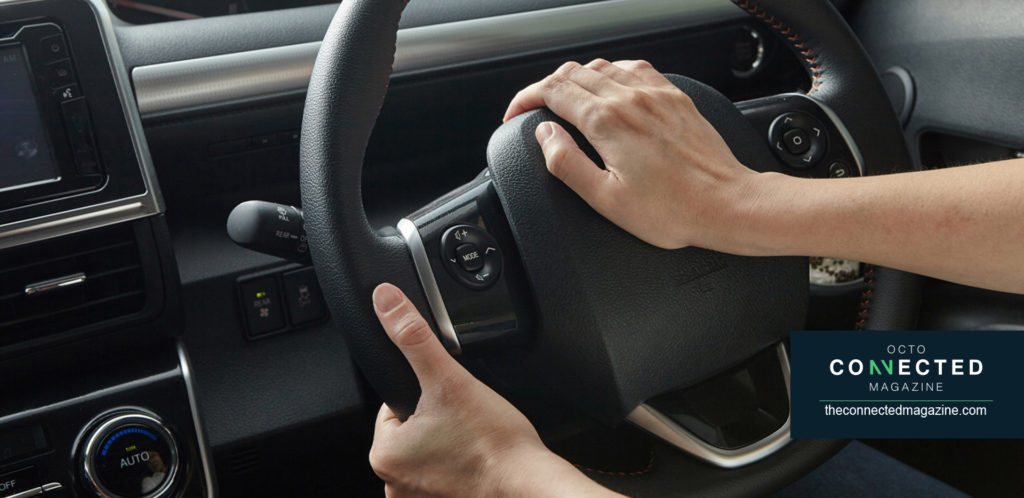
Avoid using your horn. If unavoidable, use a short honk rather than long, repeated honks.
Refrain from hand gestures and offensive or inflammatory language.
Practice patience, regardless of whether you are at an intersection, in traffic or waiting for a parking spot.
Refrain from using your high beams unless necessary to see.
As frustrating as U.S. roads can be, road rage isn’t worth the risks and dangers that it brings. The most important thing is to arrive home safely at the end of the day, and road rage will not help you there.
What to do in a road rage situation
If you are in a road rage situation, the best course of action is to remain calm and focus on getting to your destination safely. Do not engage with the other driver, do not return gestures or remarks made at you. Avoid eye contact and be sure to keep seat belts buckled in case of unexpected braking. If someone is following you as the result of a road rage situation, avoid going to your home and try to pull into a police station, fire station or another heavily populated area.
When you safely reach your destination, call 911. If possible, provide a time, date, location, license plate, vehicle description and driver description. Write down or provide a fully detailed report of the incident and prepare to appear in court if necessary.
OCTO Telematics today announced a new agreement with Ford Motor Company to extend its data streaming partnership into Europe. This builds on the initial agreement signed in the North American market in July last year[1]. By leveraging Ford’s connected vehicle data, OCTO will enhance its market proven telematics services in insurance and analytical services in the UK, Italy, Germany, France and Spain.
The integration provides a seamless experience for automotive insurers and their policyholders, with highly predictive pricing based upon Telematics driving data collected from consenting customers’ vehicles fitted with embedded connectivity.
Through this agreement, OCTO will integrate Ford’s data with its existing data sources, strengthening OCTO’s market leadership in Europe, which powers 43.5% of European Usage Based Insurance (UBI) policies2. This strengthens the power of OCTO analytics and offers a service that is accurate and envisions the insurance world’s future needs.
OCTO’s expertise in UBI service design and implementation, already gained in the aftermarket, will provide an “off-the-shelf” ready-to-play service option, that will further integrate the digitalization of insurance, via the native connectivity of Ford’s vehicles.
The European UBI market is expected to reach over 24 million policies by 20252 and embedded/line-fit solutions will be a key driver facilitating the uptake and expansion of this growth trend, representing 10% of all UBI policies2, and will enable new mobility as a service solutions.
“We are pleased to extend the Ford relationship into the EU market to leverage their connected vehicle technology to enhance insurance risk scoring for insurers and their customers as well as new mobility as a service application for the market,” said Nicola Veratelli, OCTO Group CEO, “and we look forward to exploring opportunities for incremental mobility services that benefit OCTO clients and Ford vehicle owners alike.”
Mark Harvey, Director, Enterprise Connectivity, Ford of Europe said “We are delighted to expand our relationship with OCTO in Europe. Their technology will enable our customers to benefit from the most accurate, value for money insurance policies in the market.”
About OCTO Telematics Founded in 2002, OCTO is a leading provider of telematic services and advanced data analytics for the Insurance sector, and increasingly one of the leading companies offering solutions for Fleet Telematics and Smart Mobility. With OCTO’s unique propositions already established in the field of Insurtech and Smart Mobility, OCTO continues to expand in new sectors and international markets. In the context of an increasingly connected world, OCTO’s advanced analytics and it’s set of IoT Big Data, generates actionable analytics giving life to a new era of Smart Telematics. Today it has over 5.5 million connected users and the largest database of vehicle telematics data in the world, with over 303 billion miles of driving data collected and 493,000 claims and insurance events analysed. It also manages over 400,000 vehicle rentals per month. For more information, visit www.octotelematics.com
On 28 May 2021, the Financial Conduct Authority in the UK issued a policy statement for insurers and insurance distributors defining the rules to manage the relations with the policyholders, starting 1 January 2022. Notably the new rules include a long list of factors that must be considered by the firm when measuring value for money, including the “type and quality of services provided to customers” and more.
OCTO perspective
Shifting the approach to needs-based individual pricing is somewhat more challenging but technology, data and advanced analytics combined can help insurers navigate to a new world where customization and profiling help consumers to get the product relevant for their needs, something that can increase touchpoints due to digital interactions will define a new customer journey.
Telematics is the game changer in this new playground: granular data combined with advanced analytics can help ensure the individual risk profile is understood and priced accordingly. Value-add services such as crash response, driving advice and risk avoidance tools can support the push toward a product-based future.
The advantage of telematics use can be seen when looking at future-proofing business activity; telematics-based insurance cover can provide an opportunity to manage short-term losses and mitigate long-term risk. As a result, smart telematics are becoming increasingly attractive. What may once have been seen as a ‘nice to have’ is fast becoming a necessity.
Putting in place a telematics-based model can aid in protecting against loss and premium increases and also helps empower policyholders to take a much greater stake in their own cover by encouraging responsibility and positive consumer behaviour. This could then deliver further savings on premiums in the long run.
By making the switch to telematics-based insurance cover, insurance providers will not only be able to provide much more attractive new business rates to their customer base in the light of the FCA announcement but will also be able to empower customers with new value-added services that will ensure more loyal customers.
OCTO Telematics helps clients harvest the vast insight available from driving data to help insurers price more accurately and help the shift towards true risk-based pricing. At the same time our solutions allow insurers to develop innovative products that help shift the focus toward a compelling and seamless customer journey for their customers competition on product features rather than simply on price.
OCTO can support insurers in developing new propositions such as “pay-per-mile” and “pay-how you drive” enabling tailored pricing that accurately reflects the specific risk profile of an individual driver. Our extensive experience in this area means we can help insurers get moving quickly and with a minimum of effort to respond quickly to new regulatory approach.
OCTO offering is constantly shaped by what the company has called Vision Zero – zero crashes, zero traffic, zero pollution; the company’s data-based solutions can be a great asset in improving the drivers’ behaviour and in optimizing the use of the vehicle in a greener and cost-saving manner. OCTO’s Vision Zero adds to the need of addressing the sustainability issue and helps companies belonging to the mobility ecosystem contribute to reaching some of the UN Sustainable Development Goals.”
OCTO Telematics
Founded in 2002, OCTO is a leading provider of telematic services and advanced data analytics for the Insurance sector, and increasingly one of the leading companies offering solutions for Fleet Telematics and Smart Mobility. With OCTO’s unique propositions already established in the field of Insurtech and Smart Mobility, OCTO continues to expand in new sectors and international markets. In the context of an increasingly connected world, OCTO’s advanced analytics and it’s set of IoT Big Data, generates actionable analytics giving life to a new era of Smart Telematics. For more information, visit octotelematics.com
We’re always looking for interesting ideas and content to share within our community. Get in touch and send your proposal to: press@octotelematics.com
Your privacy
This site uses cookies or similar technologies of a technical nature, including from third parties (to allow the website to function correctly and smoothly), and, with your consent, also profiling (to send advertising messages in line with your preferences expressed in the context of web browsing and/or to analyze the behavior of visitors to the site), as specified in the Cookie policy. You can manage your preferences using the 'Cookies Settings' button. We remind you that clicking on 'Reject all cookies' or closing the banner using the appropriate X, involves the persistence of default settings, and therefore you will continue to navigate in the absence of cookies other than technical ones.
Privacy Preference Center
General information
When you visit any website, it may store information on your browser, mostly in the form of cookies. This information might be about the site navigation, your preferences or data relating to the device used. Some of these cookies are used to provide you with a better browsing experience and allow you some features (Navigation or session cookies, Functionality cookies, Analytics cookies), others to send you personalized advertisements (Profiling cookies). You can choose not to allow the installation of cookies - net of the technical ones necessary for the functioning of the Site - by clicking on the headings of the relevant categories to find out more and change the settings using the "ACTIVE/INACTIVE" slider. However, disabling certain types of cookies may limit your browsing experience on the Site and the services we can offer. Octo informs users that the different types of cookies used have a persistent duration until the cookie configuration settings are changed.
Technical Cookies
Always on
The technical cookies used by Octo are necessary for the functioning of this Site. This type of cookie is used in response to user requests for services, such as authentication to access restricted areas or filling in forms. These cookies ensure the normal navigation and use of the Site. You can set the browser used for navigation to block these cookies, but some sections of the Site may not work.
Octo telematics
pll_language - www.octotelematics.com
The cookie stores the language code of the last page visited. (duration: 1 year)
PHPSESSID - www.octotelematics.com
The cookie is used to store and identify a user's unique session ID for the purpose of managing the user's session on the website. The cookie is a session cookie and is deleted when you close all browser windows. (duration: Session)
YouTube
VISITOR_INFO1_LIVE - *.youtube.com
Used to track the information of YouTube videos embedded on a website. (duration: 5 months and 27 days)
CONSENT - *.youtube.com
(duration: 16 year and 8 months)
YSC - *.youtube.com
It is used to track the views of embedded videos. (duration: Session)
Analytics Cookies
Octo uses analytics services to understand the level of effectiveness of the content, the interests of users and to improve the functioning of this Site.
Google
test_cookie - *.doubleclick.net
The purpose of the cookie is to determine whether the user's browser supports cookies. (duration: 15 minutes)
IDE - *.doubleclick.net
It stores information about how the user uses the website and any other advertisements before visiting the website. It is used to present users with advertisements that are relevant to them based on their user profile. (duration: 1 year and 24 days)
Profiling Cookies
This Site uses Profiling cookies to send targeted advertising to users, that is in line with their preferences expressed during navigation. In particular, these types of cookies are installed by third parties, advertising partners of Octo Telematics S.p.A. who may present, also on other sites, ads and advertising content based on the interests shown. The installation and use of these cookies requires the user's consent.
Facebook
_fbp - *.facebook.com
It is used to deliver advertisements when they are on Facebook or on a digital platform powered by Facebook advertising after visiting this website. (duration: 90 days)
fr - *.facebook.com
It is used to show relevant ads to users and measure and improve ads. The cookie also tracks user behavior across the web on sites that have Facebook pixels or Facebook social plugins. (duration: 90 days)
datr - *.facebook.com
The purpose of the cookie is to identify the web browser used to connect to Facebook regardless of the user who is logged in. This cookie plays a key role in the security and integrity features of the Facebook site. (duration: 2 years)
LinkedIn
lang - ads.linkedin.com
This cookie is used to store a user's language preferences to offer content in that stored language the next time the user visits the website. (duration: Session)
bcookie - *.linkedin.com
The purpose of the cookie is to enable LinkedIn features on the page. (duration: 2 years)
bscookie - www.linkedin.com
This cookie is a browser cookie ID set by the linked share buttons and advertisements tags. (duration: 2 years)
lidc - *.linkedin.com
Used for routing. (duration: 1 day)
li_gc - *.linkedin.com
Used to store the consent of users of the Site regarding the use of cookies other than technical ones. (duration: 2 years)
UserMatchHistory - *.linkedin.com
Used for LinkedIn Ads ID synchronization. (duration: 30 days)
AnalyticsSyncHistory - *.linkedin.com
Used to store information about the time when a synchronization with the lms_analytics cookie took place for users in the designated countries. (duration: 30 days)
Vimeo
vuid - *.vimeo.com
This cookie is used by Vimeo to collect tracking information. It sets a unique ID to embed videos in your website. (duration: 2 years)