OCTO will participate in the “Internet Festival 2022, which takes place in Pisa from 6 to 9 October 2022.
A conversation, introduced by Education Councillor Alessandra Nardini, between the researchers of the two regional centers, aimed at presenting in a popular way the major scientific challenges that must be faced in the coming years in order to have both a trust-based adoption of rtificial Intelligence and the design of a society that is not overwhelmed by AI but steers it in a direction that is beneficial for the individual and society. Thus, for an ‘AI not dystopia but utopia’.
On October 08, OCTO’sTina Martino will be speaking in the panel “Multidisciplinary AI Research and Innovation: exemplar cases from human mobility and health.”
Il presente articolo intende riassumere le principali evidenze emerse dalla seconda edizione dell’OCTO Connected Forum 2022, il principale evento sulla Smart Mobility in Italia e uno dei più importanti a livello globale. Il Forum si è svolto presso il Castello di Tor Crescenza con il patrocinio di Roma Capitale, del Ministero delle Infrastrutture e della Mobilità Sostenibile (MIMS) e del Ministero per l’innovazione tecnologica e la Transizione Digitale (MITD).
La seconda edizione dell’OCTO Connected Forum, andata in onda il 16 settembre 2022, ha riunito i principali stakeholder dell’ecosistema della mobilità e i rappresentanti delle Istituzioni, oltre 200 partecipanti, più di 220 mila unique viewers dal live streaming e un elevatissimo livello di apprezzamento.
Tale evento ha rappresentato l’occasione per diffondere i risultati raggiunti dalle attività di sviluppo del percorso “La Via italiana alla mobilità connessa”, date in particolare dall’avanzamento dei progetti pilota che hanno coinvolto oltre 12 stakeholder tra attori pubblici e aziende private.Inoltre, il Forum ha permesso di raccogliere diversi spunti di confronto dai diversi stakeholder chiave dell’ecosistema italiano e internazionale della mobilità, grazie alla partecipazione di 47 speaker, 28 partner e sponsor e 80 aziende.
Nel corso dell’evento è stato presentato il secondo volume del rapporto “Connected Mobility 2025” che intende disegnare lo scenario della Smart Mobility, fare il punto sugli ecosistemi di valore ad essa collegati, favorire il coinvolgimento e la partecipazione dei vari attori della mobilità connessa.
La mattinata ha ospitato l’OCTO Connected Circle, organizzato su due sessioni. Una prima dedicata alle aziende partner che stanno collaborando allo sviluppo della “Via italiana alla mobilità connessa”. A tale sessione hanno partecipato Alessandro Balboni (Senior IoT Developer, CubeCurve People), Valerio D’Angelo (CEO, Fiven), Francesca Toma (Co-Founder e Responsabile Area Business Intelligence, Wakala), Oreste Ciani (Public Cloud Sales Manager, IBM Italia), Giuseppe Costantino (Partner, BIP), Paolo Manfreddi (CEO, Leasys Rent-Drivalia; Head of European Markets & Business Development, FCA BANK) e Gabriele Ferrazzano (Head of Development Smart Mobility Services, Eni/Enjoy).
La seconda sessione della mattina è stata invece dedicata alla presentazione dei primi risultati legati all’implementazione dei 14 progetti pilota individuati da OCTO e The European House – Ambrosetti nel 2021 che hanno visto il coinvolgimento di 12 stakeholder nazionali. I partecipanti sono stati Claudio Colucci (CEO, Tecno), Edoardo Esposito (Director of Transformation and Innovation, Arriva Italia), Ruggero Rossi De Mio (CFO, SASA), Cesare Paonessa (Direttore, Agenzia Mobilità Piemontese), Gabriella De Paolis (Quality & Training Manager, Nissan Italia), Massimiliano Mascoli (Head of Insurtech, Business execution & International Business, Sara Assicurazioni), Davide Dell’Orto (CTO, Dell’Orto), Daniele Fulgenzi (Responsabile Struttura Ambiente e clima, ARIA) e Massimo Agostinelli (Public Use Sales manager, Enel X Way Italia).
Nel pomeriggio si è svolto l’OCTO Connected Forum che ha visto la consueta apertura dei lavori di Nicola Veratelli e la presentazione dei risultati dello Studio Strategico di Valerio De Molli.
A seguire, il Forum è stato strutturato su tre sessioni organizzate rispetto agli ambiti di interesse strategico dell’iniziativa “La Via italiana alla mobilità connessa”:
La mobilità connessa come abilitatore della Super Smart Society – in cui è stato trattato e approfondito il ruolo abilitante della mobilità connessa e smart per lo sviluppo delle Smart City e, in senso più ampio, di un nuovo modello di vivere le città;
Mobility-as-a-Service: tecnologie connesse per una mobilità efficiente, sicura e sostenibile – in questa sessione sono stati trattati gli aspetti relativi al ruolo delle tecnologie digitali e connesse nell’abilitare un nuovo paradigma di mobilità smart allineata con la Vision Zero di OCTO (Zero traffico, Zero incidenti, Zero inquinamento);
Ecosistemi e spazi dati: i nuovi modelli di business della mobilità – questa sessione ha trattato un ambito chiave, ovvero quello dei dati, considerati l’elemento abilitante per ogni sviluppo futuro di una mobilità connessa e smart e per la definizione di nuovi paradigmi di gestione della pianificazione urbana.
La diffusione del paradigma della smart mobility è da considerarsi l’abilitatore delle smart city. Lo sviluppo di tale nuovo paradigma dovrà essere accompagnato dalla creazione di un ecosistema co-operativo di stakeholder, pubblici e privati, che collaborano con una visione di lungo periodo;
La mobilità su gomma è una delle cause primarie della difficoltà nel raggiungimento degli obiettivi di sostenibilità. La condivisione e l’utilizzo dei dati possono essere utilizzati per migliorarei livelli di sostenibilità, ad esempio migliorando il funzionamento delle piattaforme di sharing;
Alla diffusione delle nuove tecnologie, è necessario affiancare delle policyad hoc e creare degli standard per favorire lo scambio e l’utilizzo dei datia livello europeo. In tal modo, sarà possibile creare le precondizioni necessarie per affrontare i diversi aspetti di un “sistema complesso” come quello della mobilità e delle città.
Il raggiungimento degli obiettivi e lo sviluppo dei progetti pilota della “Via italiana alla mobilità connessa” rappresenteranno un fattore di accelerazione per la diffusione di un nuovo paradigma di mobilità connessa e smart.
Il lavoro di OCTO, The European House – Ambrosetti e degli stakeholder che stanno collaborando allo sviluppo dei progetti pilota continuerà nei prossimi mesi con l’obiettivo di concretizzare lo sviluppo della “Via italiana alla mobilità connessa” in modo da presentarne i risultati in occasione dell’OCTO Connected Forum 2023.
The aim of the present article is to summarise the main findings of the second edition of the OCTO Connected Forum 2022, the main event on Smart Mobility in Italy and one of the most important globally. The Forum was held at the Tor Crescenza Castle under the patronage of Roma Capitale, the Ministry of Infrastructure and Sustainable Mobility (MIMS) and the Ministry for Technological Innovation and Digital Transition (MITD).
The second edition of the OCTO Connected Forum, broadcast on September 16, 2022, brought together the main stakeholders of the mobility ecosystem and representatives of the institutions, over 200 participants, more than 220,000 unique viewers from the live streaming and a very high appreciation level.
This event represented an opportunity to disseminate the results achieved by the development activities of “The Italian Way to Connected Mobility”, given by the progress of the pilot projects that have involved more than 12 stakeholders including public actors and private companies. Moreover, the Forum made it possible to gather various insights from the various key stakeholders of the Italian and international mobility ecosystem thanks to the participation of 47 speakers, 28 partners and sponsors, and 80 companies.
During the event, the second volume of the “Connected Mobility 2025” report was presented, which aims to outline the Smart Mobility scenario, take stock of the value ecosystems connected to it, and encourage the involvement and participation of the various players in connected mobility.
The morning hosted the OCTO Connected Circle, organised in two sessions. The first one was dedicated to the partner companies that are collaborating in the development of the “Italian way to connected mobility”. This session was attended by Alessandro Balboni (Senior IoT Developer, CubeCurve People), Valerio D’Angelo (CEO, Fiven), Francesca Toma (Co-Founder and Head of Business Intelligence Area, Wakala), Oreste Ciani (Public Cloud Sales Manager, IBM Italia), Giuseppe Costantino (Partner, BIP), Paolo Manfreddi (CEO, Leasys Rent-Drivalia; Head of European Markets & Business Development, FCA BANK) and Gabriele Ferrazzano (Head of Development Smart Mobility Services, Eni/Enjoy).
The second session of the morning was instead dedicated to the presentation of the first results related to the implementation of the 14 pilot projects identified by OCTO and The European House – Ambrosetti in 2021, which saw the involvement of 12 national stakeholders. The participants were Claudio Colucci (CEO, Tecno), Edoardo Esposito (Director of Transformation and Innovation, Arriva Italia), Ruggero Rossi De Mio (CFO, SASA), Cesare Paonessa (Director, Agenzia Mobilità Piemontese), Gabriella De Paolis (Quality & Training Manager, Nissan Italia), Massimiliano Mascoli (Head of Insurtech, Business Execution & International Business, Sara Assicurazioni), Davide Dell’Orto (CTO, Dell”Orto), Daniele Fulgenzi (Head of Environment & Climate Structure, ARIA) and Massimo Agostinelli (Public Use Sales manager, Enel X Way Italia).
In the afternoon, the OCTO Connected Forum took place, with the traditional opening of the proceedings by Nicola Veratelli and the presentation of the results of the Strategic Study by Valerio De Molli.
Following this, the Forum was structured into three sessions organised around the areas of strategic interest of the initiative “The Italian Way to Connected Mobility”:
Connected Mobility as an enabler of the Super Smart Society: the enabling role of connected and smart mobility for the development of Smart Cities and, in a broader sense, of a new model of city living was discussed and explored;
Mobility-as-a-Service: connected technologies for efficient, safe and sustainable mobility – this session dealt with aspects related to the role of digital and connected technologies in enabling a new paradigm of smart mobility aligned with OCTO”s Vision Zero (Zero Traffic, Zero Accidents, Zero Pollution);
Ecosystems and Data Spaces: New Mobility Business Models – this session dealt with a key area, namely that of data, considered the enabling element for any future development of a connected and smart mobility and for the definition of new urban planning management paradigms.
A total of 28 panellists, including C-level, professors, and institutional representatives, contributed to the three sessions. From the discussions of these experts, three key messages were identified:
The spread of the smart mobility paradigm is to be considered the enabler of smart cities. The development of this new paradigm must be accompanied by the creation of a co-operative ecosystem of public and private stakeholders working together with a long-term vision;
Road mobility is one of the primary causes of the difficulty in achieving sustainability goals. Data sharing and utilisation can be used to improve sustainability levels, e.g., by improving the functioning of sharing platforms;
Alongside the spread of new technologies, it is necessary to create ad hoc policies and standardsto facilitate the exchange and use of data at the European level. In this way, it will be possible to create the necessary preconditions for dealing with the different aspects of a “complex system” such as that of mobility and cities.
The achievement of the objectives and the development of the pilot projects of the “Italian way to connected mobility” will be an “accelerating factor” for the diffusion of a new paradigm of connected and smart mobility.
The work of OCTO, The European House – Ambrosetti and the stakeholders who are collaborating in the development of the pilot projects will continue in the coming months with the aim of concretising the development of the “Italian Way to Connected Mobility” to present its results at the OCTO Connected Forum 2023.
OCTO will participate in the“AFLA Corporate Fleet Conference“, which takes place in Tucson, AZ, from 10 to 13 October 2022.
The AFLA Corporate Fleet Conference is the advanced forum dedicated to improving communication between sellers, buyers, fleet managers, lending institutions, fleet management companies, used vehicle marketers, and allied automotive service companies.
OCTO’s Nick Ehrhart, VP of Sales – North America will be attending the “AFLA Corporate Fleet Conference”.
OCTO will participate in the“Digital Dealer“, which takes place in Las Vegas, from 11 to 13 October 2022.
The Digital Dealer brings together automotive dealers, OEMs, thought leaders, and solution providers for a 2.5-day experience of exploration, development, and collaboration to bridge critical gaps and curate growth plans.
Eva Van Eenoo, Koos Fransen and Kobe Boussauw, from the Cosmopolis Centre for Urban Research, Vrije Universiteit Brussel, Belgiumpublished an article in EJTIR on march 2022, regarding car dependence and multimodality. The article provides an a-up to date review on this issue. Here are some of the key issues.
The private car remains the main mode of personal transport in the EU and despite the considerable benefits that come with reducing motorized traffic, car ownership in the EU increases. In 2019, the European Union car fleet grew by 1.8% compared to 2018, with the number of cars on the road reaching 242.7 million. In addition, car ownership has increased from 2015 to 2019 from 553 to 569 cars per one thousand inhabitants.
The figures mentioned hide variations in travel patterns and mode use. Against this backdrop, multimodality is increasingly gaining attention. Multimodality is most commonly defined as the use of at least two modes during a specific time period. It is found that multimodality is more prevalent in areas with higher population densities.
Car dependence of individuals may be composed of two elements: the absolute need for a car, and the perception of reliance on a car. In the case of ‘structural’ car dependence there is absolutely no reasonable alternative for the car available. In the case of ‘conscious’ dependence, alternative transport modes are present but are not actively considered. The study points out that this distinction as perceived versus actual car dependence.
However, it is not clear if multimodal travel patterns lead to a lower perceived car dependence. Using cluster analysis, the research aims to fill this gap and explore if and in what way multimodality correlates with perceived car dependence.
Study area
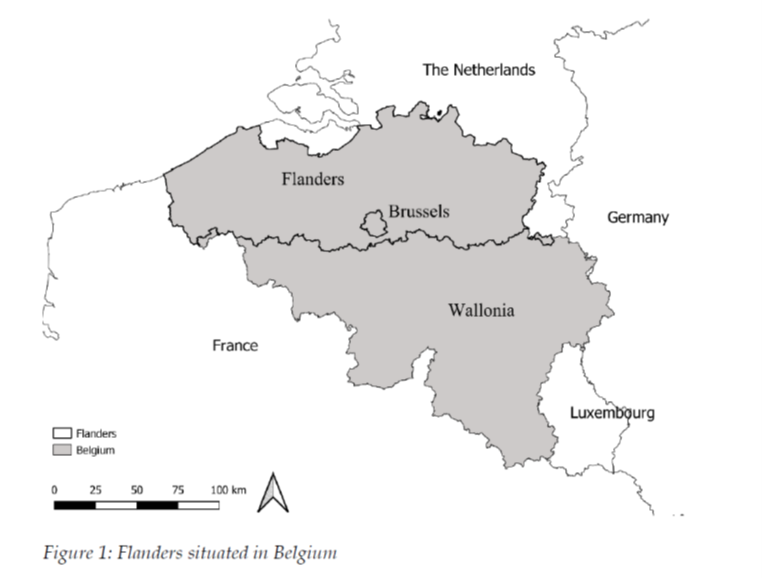
The geographical scope of the research are urbanized areas in the Flemish region in Belgium. On average, 69.6% of the trips in the Flemish region are carried out by car (as a driver or as a passenger), although the car accounts for 82.3% of the Vehicle Kilometers Traveled (VKT). Overall, 12.4% and 11.4% of all trips are carried out respectively by bicycle and on foot. Only 4.5% of all trips are undertaken with public transport.
In the selected areas, the authors carried out an online survey between October 2019 and February 2020, specifically targeting individuals with at least one car in the household and in the possession of a driving license.
Car-dependent motorists long distance (CDML)
From the group of car-dependent motorists, 89.5% use a car daily. This is the highest score of all clusters. Their perceived car dependence is the highest of all clusters: 92.6% agree with the statement. However, this does not imply that this group is unimodal, as 41.2% ride a bicycle at least weekly.
Car-dependent motorists short distance (CDMS)
Similar to the car-dependent motorists long distance, for respondents of the car-dependent motorists short distance cluster, the car is the dominant mode of transport. In the same vein, their perceived car dependence is high, although slightly less than for the CDML. This group does not frequently travel by bicycle. Nevertheless, we could also consider this group as multimodal, as they compensate for their low bicycle use by a higher share of trips by bus or tram.
Their perceived car dependence is high, and it is conceivable they expect difficulties in the case of forced relinquishment of their car. They are more inclined to take the bus or tram than to ride a bicycle. This group is lower educated, has the lowest average income of the four clusters. Higher age groups are overrepresented.
Car-independent cyclists (CIC)
As the name suggests, for the car-independent cyclists (CIC), the dominant mode of transport is the bicycle, and this is the group with the lowest perceived car dependence. This group is more multimodal than both motorists groups. Respondents from this group have a significantly higher propensity to travel by train or bus, although the percentages remain rather low, and for a majority, public transport is excluded from their travel mode set.
Compared to the sample average, respondents in CIC are more likely to have only one car in the household. Females and younger age groups are overrepresented here, as are couples with children. As far as education is concerned, we notice that the CIC are on average highly educated. The CIC tend to use a car primarily for leisure. This is a highly educated group, of all four the most willing to abandon a car if costs would increase drastically.
Car-dependent cyclists (CDC)
Finally, we turn to the car-dependent cyclists (CDC). As for the former cluster, the bicycle is the dominant mode choice. Nevertheless, 86.2% of this group travels by car at least once a week. Their perceived car dependence is equal to that of the CDMS. Use of public transport is more of an exception than a rule. With respect to socio-economics, most of the features of the CDC are close to that of the sample average, with two exceptions: highly educated respondents are overrepresented and households with children are underrepresented.
To summarize, the CDC is characterized by weekly car use, daily bicycle use, but a high perceived car dependence. They do not stand out socio-economically, although their high education is remarkable. This is the group most willing to start car sharing.
Discussion and conclusion
Firstly, the authors found that all clusters are to some extent multimodal. In general, the research can conclude that, for our selected study area, car ownership does not necessarily induce perceived car-dependence for people who can easily get around by bicycle. Nevertheless, even in an urban setting and when exhibiting multimodal travel patterns, people can perceive their car as indispensable. Perceived car dependence is not necessarily correlated with high VKT or high frequency of car use, neither can this investigation conclude that multimodality necessarily leads to less VKT. In this urbanized study area, at least for trips in the proximity of the dwelling to for instance services, people are willing to consider other modes than a car.
The four clusters reflect well-established correlations between travel behavior and socio economic characteristics. As income rises, it becomes more likely people undertake social and leisure trips. As far as education is concerned, we notice that both groups of cyclists are highly educated.
As households with children are overrepresented in the car-independent cyclists group, and underrepresented in the car-dependent cyclists group, the results also illustrate that perceived car dependence goes not necessarily hand in hand with the presence of children.
Despite the presence of multimodality, the attachment to the car is strong.
This confirms the asymmetry Dargay discovered: once the household budget allows the purchase of a car, people become accustomed to using it. When income drops (or in our case: a larger share of the household budget needs to be transferred to maintaining the car), this does not necessarily lead to relinquishing the car. In that sense, financial incentives to reduce car use or to abandon the car risk not being very successful.
The car-independent cyclists are less dependent on a car for daily trips, and this might explain why their perceived car dependence is lower. For them, a car is more for convenience or to carry out flexible leisure trips.
Furthermore, the researchers find it remarkable that the willingness to start car sharing is limited in this group, as this could combine the convenience of a car with reduced costs.
Policy implications
An issue to address is whether policy attention should mainly focus on the groups with the highest likelihood of mode switching, like the car-independent cyclists, or should reducing VKT, crucial in the light of continuous increase of greenhouse emissions, be on top of the agenda. Of course, both are needed. The effectiveness of policy actions depends on the level of governance. The authors consider the local level more suited to politically intervene in straightforward measures like improving bicycle infrastructure and land use policies that strengthen proximity.
The results confirm that multimodality already prevails in urban areas, and that car owners display aspects of multimodal behavior, even when they travel by car frequently and they cover substantial VKT. As such, they are already experienced with sustainable modes like the bicycle or public transport. A stronger focus on making these modes more accessible could further reduce car use. In urban areas, to a certain extent, the bicycle is capable of replacing car trips in the proximity of the dwelling. However, the study stresses that older people, lower incomes and lower educated groups, are less inclined to cycle.
The research indicates that older people and lower incomes have the highest propensity of using the bus or train. They could strongly benefit from an expansion of the network and higher frequencies. As higher VKT leads to higher greenhouse gas emissions, the authors think the train can have an important role, especially for leisure, with increased service provision during weekends and nighttime hours.
Measures that favor the bicycle and public transport, have to be combined with car-restrictive measurements.The car-dependent motorists group, a lower educated group with a lower income, are probably the most vulnerable to car restrictive financial measures. They probably already reduce VKT as much as possible as a cost-saving strategy. Car-reducing regulations that rely on financial incentives, tend to disproportionately hit this group, while higher incomes can easily ‘buy their way out’. Policy should take these concerns into account.
Finally, policy makers should not consider multimodality as a goal in itself, as multimodality not necessarily leads to less VKT or less car use. The main goal needs to be reducing car ownership and car use and the implementation measures to reach that goal, taking into account equity concerns.
Become a Contributor!
We’re always looking for interesting ideas and content to share within our community. Get in touch and send your proposal to: press@octotelematics.com
Your privacy
This site uses cookies or similar technologies of a technical nature, including from third parties (to allow the website to function correctly and smoothly), and, with your consent, also profiling (to send advertising messages in line with your preferences expressed in the context of web browsing and/or to analyze the behavior of visitors to the site), as specified in the Cookie policy. You can manage your preferences using the 'Cookies Settings' button. We remind you that clicking on 'Reject all cookies' or closing the banner using the appropriate X, involves the persistence of default settings, and therefore you will continue to navigate in the absence of cookies other than technical ones.
Privacy Preference Center
General information
When you visit any website, it may store information on your browser, mostly in the form of cookies. This information might be about the site navigation, your preferences or data relating to the device used. Some of these cookies are used to provide you with a better browsing experience and allow you some features (Navigation or session cookies, Functionality cookies, Analytics cookies), others to send you personalized advertisements (Profiling cookies). You can choose not to allow the installation of cookies - net of the technical ones necessary for the functioning of the Site - by clicking on the headings of the relevant categories to find out more and change the settings using the "ACTIVE/INACTIVE" slider. However, disabling certain types of cookies may limit your browsing experience on the Site and the services we can offer. Octo informs users that the different types of cookies used have a persistent duration until the cookie configuration settings are changed.
Technical Cookies
Always on
The technical cookies used by Octo are necessary for the functioning of this Site. This type of cookie is used in response to user requests for services, such as authentication to access restricted areas or filling in forms. These cookies ensure the normal navigation and use of the Site. You can set the browser used for navigation to block these cookies, but some sections of the Site may not work.
Octo telematics
pll_language - www.octotelematics.com
The cookie stores the language code of the last page visited. (duration: 1 year)
PHPSESSID - www.octotelematics.com
The cookie is used to store and identify a user's unique session ID for the purpose of managing the user's session on the website. The cookie is a session cookie and is deleted when you close all browser windows. (duration: Session)
YouTube
VISITOR_INFO1_LIVE - *.youtube.com
Used to track the information of YouTube videos embedded on a website. (duration: 5 months and 27 days)
CONSENT - *.youtube.com
(duration: 16 year and 8 months)
YSC - *.youtube.com
It is used to track the views of embedded videos. (duration: Session)
Analytics Cookies
Octo uses analytics services to understand the level of effectiveness of the content, the interests of users and to improve the functioning of this Site.
Google
test_cookie - *.doubleclick.net
The purpose of the cookie is to determine whether the user's browser supports cookies. (duration: 15 minutes)
IDE - *.doubleclick.net
It stores information about how the user uses the website and any other advertisements before visiting the website. It is used to present users with advertisements that are relevant to them based on their user profile. (duration: 1 year and 24 days)
Profiling Cookies
This Site uses Profiling cookies to send targeted advertising to users, that is in line with their preferences expressed during navigation. In particular, these types of cookies are installed by third parties, advertising partners of Octo Telematics S.p.A. who may present, also on other sites, ads and advertising content based on the interests shown. The installation and use of these cookies requires the user's consent.
Facebook
_fbp - *.facebook.com
It is used to deliver advertisements when they are on Facebook or on a digital platform powered by Facebook advertising after visiting this website. (duration: 90 days)
fr - *.facebook.com
It is used to show relevant ads to users and measure and improve ads. The cookie also tracks user behavior across the web on sites that have Facebook pixels or Facebook social plugins. (duration: 90 days)
datr - *.facebook.com
The purpose of the cookie is to identify the web browser used to connect to Facebook regardless of the user who is logged in. This cookie plays a key role in the security and integrity features of the Facebook site. (duration: 2 years)
LinkedIn
lang - ads.linkedin.com
This cookie is used to store a user's language preferences to offer content in that stored language the next time the user visits the website. (duration: Session)
bcookie - *.linkedin.com
The purpose of the cookie is to enable LinkedIn features on the page. (duration: 2 years)
bscookie - www.linkedin.com
This cookie is a browser cookie ID set by the linked share buttons and advertisements tags. (duration: 2 years)
lidc - *.linkedin.com
Used for routing. (duration: 1 day)
li_gc - *.linkedin.com
Used to store the consent of users of the Site regarding the use of cookies other than technical ones. (duration: 2 years)
UserMatchHistory - *.linkedin.com
Used for LinkedIn Ads ID synchronization. (duration: 30 days)
AnalyticsSyncHistory - *.linkedin.com
Used to store information about the time when a synchronization with the lms_analytics cookie took place for users in the designated countries. (duration: 30 days)
Vimeo
vuid - *.vimeo.com
This cookie is used by Vimeo to collect tracking information. It sets a unique ID to embed videos in your website. (duration: 2 years)