Year: 2022
EICMA – Esposizione Internazione delle due ruote
OCTO will participate in the “EICMA“, the most important trade fair for the two-wheel sector, taking place in Milan, 10th to 13th November 2022.
There are numerous elements that make EICMA a showcase of great impacts: numerous product innovations, international press conferences, technical workshops, the presence of world-class riders and sector representatives, as well as competitions and a MotoLive show.
OCTO will be present at the Dell’Orto booth to talk together about the CEMP project, an ‘intelligent’ electric propulsion project for light vehicles, focusing on energy, environmental and social sustainability.
Don’t miss the opportunity to connect with us!
Electric vehicles
A paradigm shift in automotive purchasing linked to the electric vehicle transition is creating a major growth senior expert in the McKinsey’s Munich office, published an article in McKinsey & Company in 2022 named “Electric vehicles: The next growth engine in chemicals”. The article provides an up- to-date review on this issue. Here are some of the key issues.
The automotive market is undergoing rapid change. Based on a forecast by the McKinsey Center for Future Mobility, battery electric vehicles (BEVs) and plug-in hybrid electric vehicles (PHEVs) will make up more than 55 percent of new vehicle production by 2030 across China, Europe, and North America. This represents 47 million units globally—seven times more than in 2021.
Opportunity for chemical companies
Authors Guttorm Aase, associate partner in McKinsey’s New York office, Chris Musso, senior partner in the McKinsey’s Denver office, and Dennis Schwedhelm,
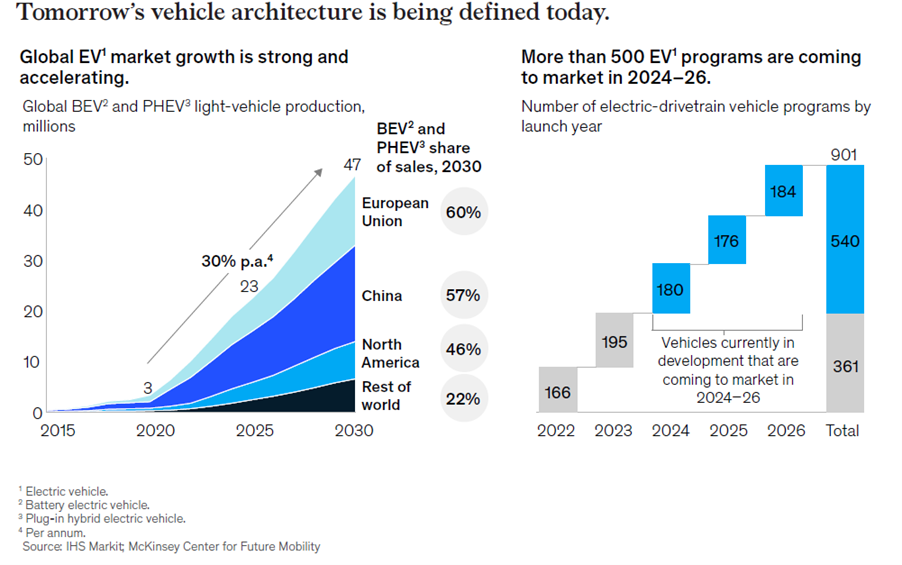
Adoption has moved beyond start-ups, with all mainstream OEMs now focused on electric vehicles (EVs) and with forecasts for EV penetration continuing to accelerate: more than 500 EV programs will come to market from 2024 to 2026 alone. In short, the study points out that tomorrow’s vehicle architecture is being defined today, offering a narrow window of opportunity for chemical companies to set the standard for materials applications in the years to come.
Although EVs have been a hot topic in the chemicals industry for some time, the researchers stress that a major paradigm shift in automotive procurement practices has made the space dramatically more attractive for chemical players (not considering cell chemistry, a market governed by unique value chain dynamics). Whereas chemicals in the automotive industry were traditionally considered on a unit-cost basis— with suppliers barely able to hold value over the program life cycle—savvy automotive OEMs and tier suppliers are now moving to a system value approach. These players recognize that materials solutions can provide outsize value in reducing cost and improving the reliability of expensive parts such as batteries, power electronics, and electric motors.
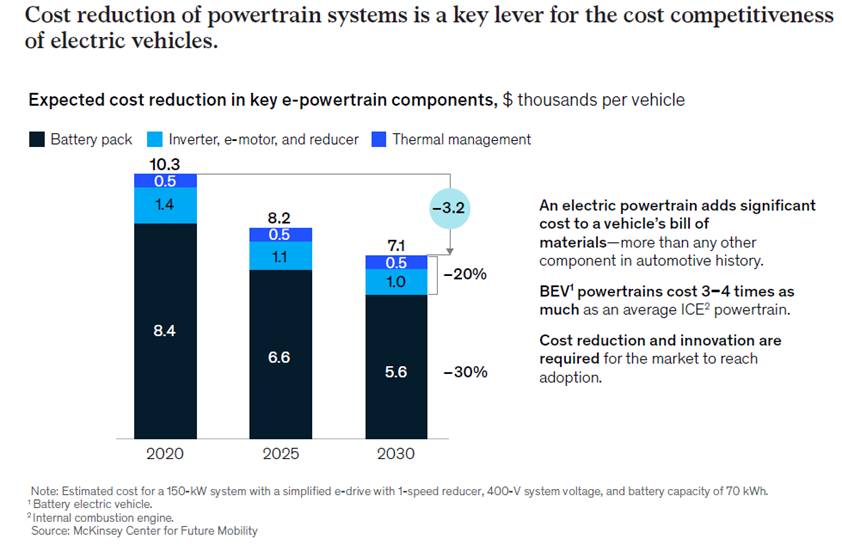
To illustrate this point, the authors consider the powertrain of a typical BEV. The battery, inverter, and electric motor together cost more than $10,000—often three to four times the cost of their equivalent parts in a conventional combustion engine vehicle. Hence, the vehicle system must come down in cost for BEVs to gain widespread adoption.
In this context, leading OEMs have discovered that using the right thermal and insulation materials in the powertrain can lead to significant increases in system efficiency and reductions in warranty cost, which together can be worth several hundred dollars per vehicle. These savings make it much easier for OEMs to invest in enabling these materials.
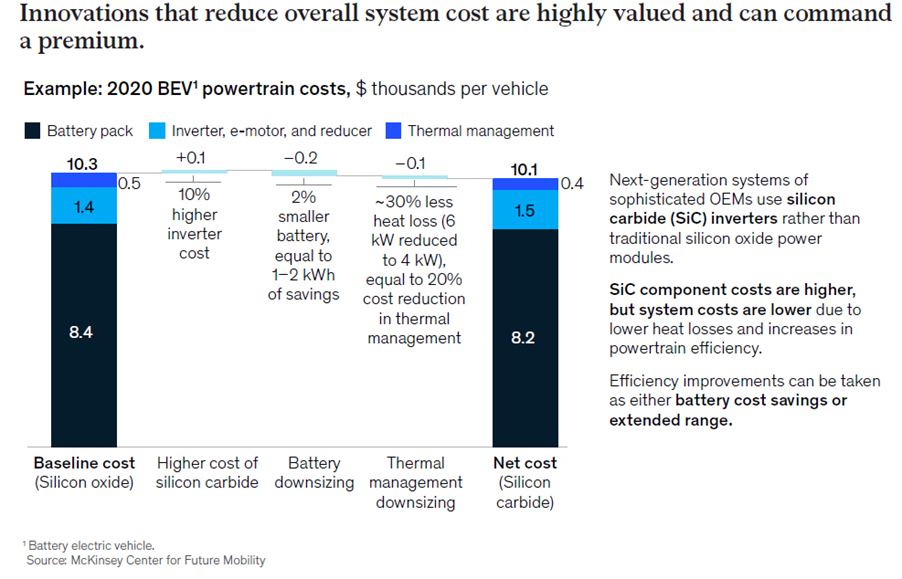
For example, a transition from silicon oxide (Si) to silicon carbide (SiC) power modules in the inverter can generate system savings on the order of $200 per vehicle for OEMs. This is because of the semiconductor’s greater power efficiency (reducing battery cost) and more optimal cooling profile (reducing thermal management cost), despite SiC costing more than Si counterparts. Consequently, innovations in materials that enable system cost reductions can provide tremendous value to OEMs.
Electric-vehicle value pools for chemical players
The study indicates that high-value challenges that drive the benefits of vehicle systems primarily occur in the powertrain. The industry for specialty materials in these applications—not including battery cell chemistry— could see an industry value pool of more than $20 billion by 2030, focused on high-value challenges linked to power efficiency, thermal management, and battery life.
— Power electronics. OEMs have the potential to improve power efficiency further through wide bandgap electronics, including the previously mentioned transition from Si to SiC materials. The EV industry is making a significant shift to more expensive, more efficient, higher temperature inverter technology that will require better thermal and isolation materials.
— Motors and wiring. Several OEMs have demonstrated superior EV performance through high-voltage (greater than 800 volts) systems. The laws of physics dictate that a higher voltage is more electrically efficient; in turn, much better electrical insulation and more reliable connector materials must be used to maintain system safety. In most cases, the value of higher system efficiency dwarfs the additional cost of superior materials.
— Batteries. It is no secret that battery costs need to drop dramatically for EVs to become cost efficient—and that battery safety is paramount. Although most discourse seems to be focused on the chemistry and supply-and demand balance of battery cell materials, many progressive OEMs have recognized that plastics, silicones, mica, and other thermal materials can be engineered together to significantly reduce system costs.
How to make it happen
To understand where the greatest potential for value creation lies and to maximize the likelihood of capturing it, the authors emphasize that materials players should answer the following five questions:
- What are the growing value pools and valuable problems to solve in EVs? Chemical companies will see outsize value from materials innovations that solve power efficiency, thermal management, and warranty challenges.
- Where can our materials portfolio play to enable the creation and capture of value? Companies should articulate their value proposition based on the value OEMs can derive from solutions, applying a systems-based lens to cost reductions.
- What are the ‘big bets’ that could allow us to address more value pools? This includes prioritizing technologies that enable integrated solutions to the most valuable OEM problems. Furthermore, scenarios can be used to evaluate investments in technologies with high levels of uncertainty, such as future cell formats and chemistry.
- What capabilities are needed to deliver on the solutions? This will involve deeper application engineering with OEMs in the vehicle design stage, system-testing capabilities to build a fact-based value proposition, and key account and risk management vis-à-vis OEMs. Mobilizing commercial and technology teams quickly is important because design decisions are being made now for future model platforms.
- Who are the key customers to target, and what is the right go-to-market model? Chemical companies should take a differentiated approach to customers via a tailored value proposition based on OEMs’ make-versus-buy strategies, and they should consider value chain position trade-offs based on natural owner and customer proximity.
Finally, the researchers stress that chemical companies hold the keys to the cost challenges for OEMs in many critical component areas and can play pivotal roles in unlocking the automotive electrification transformation.
OCTO Dealer Solution
The New Solution Launched by OCTO Changes the Concept of Customer Engagement

OCTO Dealer offers an out-of-the-box service to reduce costs and provide the customer with a unique connected car management experience
Rome, October 2022 – OCTO Telematics, a leading provider of telematics services and advanced data analytics solutions for the insurance, Fleet Telematics and Smart Mobility industries, today unveiled OCTO Dealer, a solution designed to enable the dealer to establish and maintain a digital connection with their customers by leveraging an ongoing engagement channel that aims to turn occasional customers into loyal ones.
OCTO believes that customer loyalty supported by the potential offered by technology is critical to the economic growth and increased profitability of dealers.
Accordingly, OCTO Dealer Solution enables dealers to establish and maintain a profitable and lasting digital connection with their customers. By making the most out of OCTO’s digital expertise and the advanced diagnostic capabilities of connected cars, OCTO Dealer provides customers who download the app with a 24/7, remote monitoring service to check the car’s maintenance and operating status; it also allows them to be contacted for appointments or urgent intervention. The solution also makes it possible to manage customer loyalty through point-collection campaigns and rewards.
OCTO Dealer is the perfect solution for dealers who would like to develop an ongoing and profitable relationship with their customers and be always close to their drivers’ thanks to the digitization of services.
OCTO Telematics
OCTO has always been at the forefront of innovation in the connected mobility sector. A pioneer in insurance telematics, today the company is the main advanced telematics and technology solutions provider also in the Fleet Management and Smart Mobility industries, leveraging Machine Learning and AI to transform IoT data into actionable intelligence.
Thanks to its know-how, the expertise developed in 20 years of global advanced analytical services and its M&A strategy, OCTO is spreading the value of advanced data analytics to serve worldwide end users of different mobile applications with a superior customer experience.
Through different business applications and use cases, OCTO is bringing telematics to the core of smart cities as an advocate of the global goals of sustainability thanks to OCTO Vision Zero: Zero Crashes, Zero Congestion, Zero Pollution.
OCTO has currently 5,5 million connected users, holds the largest global database of telematics data, with more than 510 billion miles of driving data collected and over 501,000 crashes and insurance events analyzed, and an operational management capacity of over 400.000 hires per month.
OCTO Telematics Media contact
Adriana Zambon
+39 339.3995640
Challenging accessibility standards: looking at an ideal electric car charging station
Electric vehicles (EVs) are continuing to change the face of the automotive industry. Their benefits go far beyond reducing the emissions created by fossil fuel-powered cars, offering drivers a smoother, more relaxing experience. EVs have also shown to be highly beneficial for drivers with certain disabilities, helping these individuals to maintain their freedom by making it easier for them to get behind the wheel.
But there’s little doubt that certain barriers still have to be overcome before there can be widespread takeup of EVs within the disabled community. One of the most prevalent is fears around the accessibility of public charging stations. Home charging points will go a long way to alleviate these fears, but for EVs to become a totally viable option, it’s essential that public stations can cater to anyone with accessibility needs.
In this post, we’ll explore some of the current challenges that charging stations present disabled EV drivers, and discuss how these challenges can be overcome.
Sharing information around accessibility
If you’re unfamiliar with an area, and aren’t sure where the nearest stations are, you may also worry about whether or not the closest one will be accessible. To overcome this, the UK Government is working to implement a set of standards that, when rolled out, will make it easier for disabled drivers to use public charging points across the country.
Part of their plans concerns creating a ranking system that details how accessible any given charging station is, from fully accessible, to not accessible. This will help to take away some of the anxiety around not knowing if a driver will be able to use a public charging station, particularly when visiting an unfamiliar area.
Wheelchair access
Wheelchair accessibility is one of the most important considerations in determining whether or not a public charge point is fully accessible. There are lots of different elements to a charging station that could make it difficult to access for wheelchair users.
Firstly, both the height of the kerb (for on-street charging points) and the charger itself both have to be low enough so drivers using a wheelchair can easily use the technology. What’s more, in charging forecourts, there has to be ample space between charge points to allow people in wheelchairs to freely move around the station without obstruction.
As reported in this guide to EVs for drivers with disabilities, pop-up charge point company Urban Electric are working to address accessibility standards within their network. For instance, they’ve designed technology that allows users to automatically adjust the height of an electronic charging bollard via an app. Innovations such as this will likely play a crucial role in making the use of charge points more accessible for many years to come.
To sum up
It’s clear that there is lots that can be done to improve charging facilities for EV drivers with all different types of disabilities. Whilst there is a long way to go, the signs are promising, with the government already taking the necessary steps to implement universally accessible charging stations across the country, helping to drive the shift towards an electric future.
https://www.autotrader.co.uk/cars/electric/ev-drivers-with-disabilities/
World Intelligent Insurance Summit
OCTO will participate in the “Word Intelligent Insurance Summit” which takes place in Berlin, from 20 to 21 October 2022.
The “World Intelligent Insurance Summit” will focus on the latest strategies and innovations for more efficient claims management, improved and personalized services for customers of tomorrow and many other important topics. This hybrid event will bring together insurance specialists, brokers, underwriters, claims experts and other industry leaders, to discuss game-changing technologies transforming the insurance sector, to provide better customer experiences while reducing policy costs, improving risk management and remaining compliant with regulations.
OCTO’s Martin Otter, Global Insurance Stream Leader will be attending the “Word Intelligent Insurance Summit”.
Don’t miss the opportunity to connect with us!