Request a Demo

Air Taxi Services for Urban Mobility

Researchers Suchithra Rajendran and Sharan Srinivas, from the Department of Industrial and Manufacturing Systems Engineering, College of Engineering, Department of Marketing, University of Missouri, Columbia, USA, published an article creativecommons.org in 2020 regarding the air taxi service for urban mobility.  The article provides an up-to-date review on this issue. Here are some of the key issues.

Traffic congestion has become a ubiquitous problem in urban areas due to various reasons, such as high population density, increase in privately-owned vehicles, rise in the number of commuters traveling from low-density areas where public transits do not serve passengers effectively, and average household income inflation In metropolitan cities, such as Los Angeles and New York, an average commuter spends over 90 minutes in traffic resulting in an increase in stress and anxiety. Such congestions also lead to 330 grams per mile of CO2 emissions into the atmosphere. Besides having a detrimental impact on the health of the commuters and the environment, it also contributes to economic loss. For instance, Manhattan experiences an annual loss of $20 billion due to traffic congestion, with the excess fuel and ve hicle operating cost accounting for nearly 13% of the total loss.

Several logistics companies and aviation agencies are striving to leverage urban air mobility (UAM) using flying taxi services, an aviation ride-hailing concept, that is expected to launch in the forthcoming years.

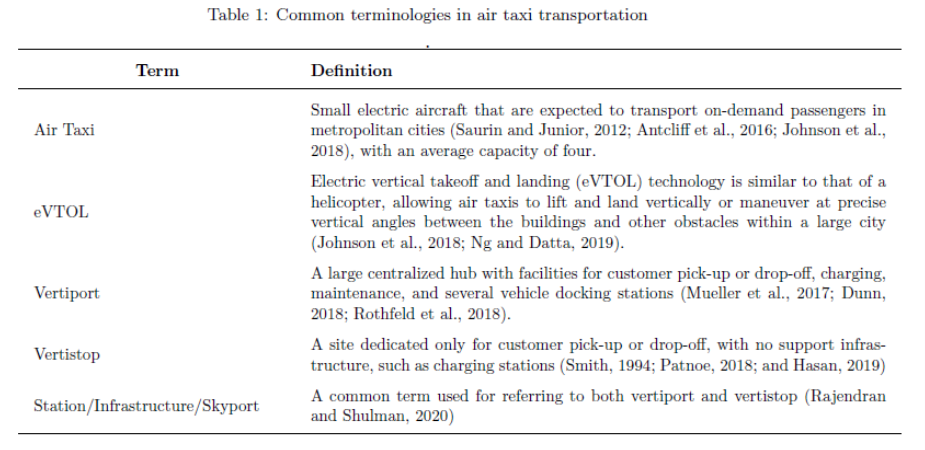
Through the use of proposed fully electric vertical takeoff and landing (eVTOL) vehicles, air taxi service (ATS) could offer a faster and reliable mode of transportation.

An ATS shares the characteristics of common transportation modes, such as regular taxis and subways. The experience of requesting an ATS would be similar to the process of booking a standard on-demand mobility (ODM) service. Typically, a registered customer will enter the pickup and drop-off locations using a ridesharing application. Depending on the trip information, the platform will estimate the fare amount and travel time for all applicable transportation modes, such as air and regular taxis.

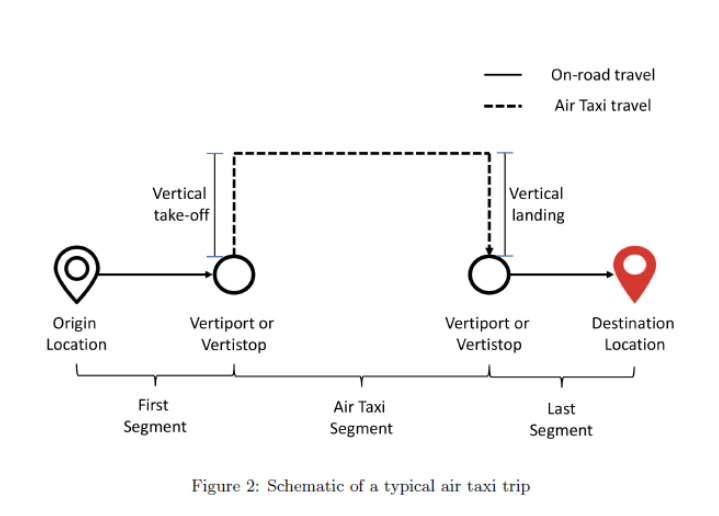
An ATS is anticipated to have multiple segments. The first segment of the trip (commute from the pickup location to a vertiport/vertistop) is facilitated by the ridesharing platform via on-road car trips. Subsequently, the longest segment of the trip is covered by an air taxi, where the passenger is transported from the origin skyport to the destination station. Finally, the last mile of the trip (i.e., travel from the destination skyport to the drop-off location) is again complemented by regular taxis.
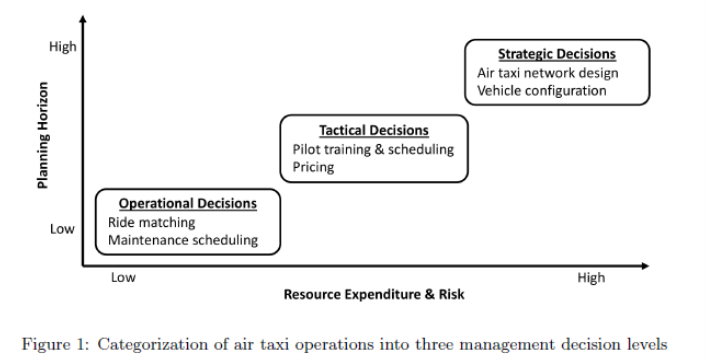
Air Taxi Network Design

The study highlights that many factors contribute to a location being chosen as a strategic operating station, such as the demand density, existence of adequate area for safe departure/landing, availability of space for charging stations, and easy accessibility.

Several studies propose to repurpose existing rooftop helipads, floating barges, the centers of interstate turnabouts, and top levels of parking garages, as they offer compelling space and locational advantages for urban operations. Using such existing structures or facilities would allow faster implementation and lower overhead costs over the short-term.
Ride-Matching

Ride-matching is the process of assigning one of the available vehicles to a customer request.

For any on-demand, ride-hailing service (on-road or air taxi), efficient matching of commuters (demand) with vehicle (supply) is crucial for minimizing customer wait time and vacant/empty trips. The flexibility in matching a request to a vehicle depends on the market type. In a one-sided market (OSM), the platform has only one group of customers (demand-side/commuters) as it controls the entire supply of vehicles (and drivers). On the other hand, the platform acts as an intermediary between the two groups of customers (independent drivers who own the vehicle, as well as riders) for a commission in a two-sided market (TSM).

As the supply and demand are expected to vary over time and location, these matching systems should be automatic and dynamic to facilitate swift on-demand coordination. The complexity of trip matching depends on the type of ride-hailing request, which can be broadly classified into two categories:

• Single Customer Service per Trip: The vehicle transports an individual customer from a pickup point to a destination location.

• Multiple Customer Service per Trip (Ridesharing): The vehicle accommodates numerous customer requests, which occur around the same time and have a different, but nearby, origin as well as destination locations on a trip.

The on-road segment of ATS is equivalent to the operations of existing on-demand ride services, such as Uber and Lyft. Therefore, matching algorithms of these ODM services can be adapted for transporting the rider from the pickup location to a skyport or from a station to the drop-off location.

The authors stress that the efficiency of the on-road segment can be improved by involving shared rides. The inherent advantages of ridesharing are lower trip cost, conservation of fuel, reduced traffic congestion, lessened travel time, and reduced air pollution. Nevertheless, the matching process becomes even more complicated when incorporating shared rides. Specifically, sequencing the pickup and drop-off of multiple passengers in ridesharing complicates the decision process and makes the optimal pooling problem hard to solve.

Pricing Strategies for On-Demand Mobility

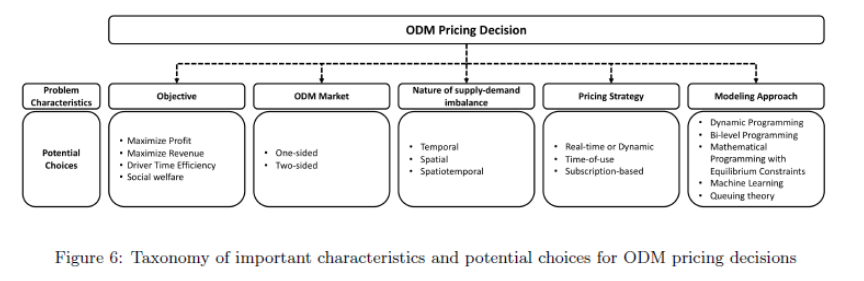
Pricing refers to the method of establishing the passenger fare for an ATS. Besides base fare (a flat fee per ride), the trip cost would also be impacted by ride distance, duration, booking fees, price multiplier, promotions, and ridesharing discounts Determining the pricing scheme for an ODM service is a crucial problem as it has a direct impact on supply-demand equilibrium and revenue. Typically, a customer pays more than the regular price in the case of high demand and low supply.
A subscription-based pricing strategy can be adopted as it protects customers from high price fluctuations by charging a fixed fee per time period in advance.

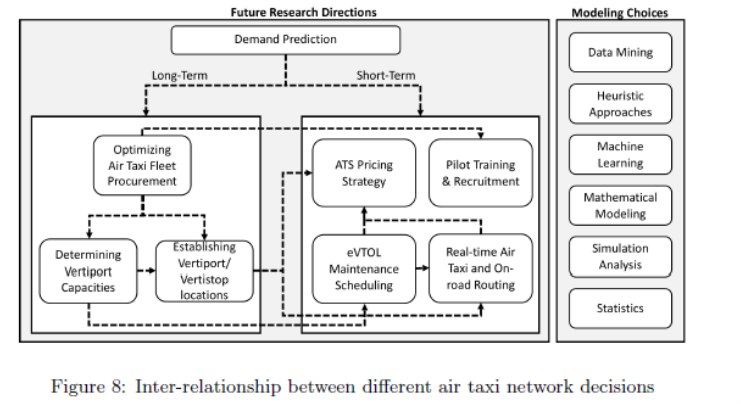
Opportunities for Future Research Directions

Based on the review of the current developments and challenges in the literature pertaining to air taxi systems, the researchers observe the following research areas to be under-explored: 

–Optimizing Fleet Procurement: the availability of air taxis at the right time at the right  place is essential to maintain a specified customer service level, while minimizing cost.

-Pricing Strategy for Air Taxi Operations: determining the optimal pricing strategy for regular taxis is extensively discussed in the literature.

-Integration of Ground and Air Transportation Scheduling: to ensure door-to door services for customers, ATS is complemented by ground transportation for the first and last-mile delivery.

-Leveraging Mobility as a Service (MaaS) Facility for ATS: the incorporation of other intermodal transportation with ATS could also be examined in the future. For instance, research related to Mobility as a Service (MaaS) attempts to deliver affordable ODM commutes leveraging existing public transportation infrastructure.

-Pilotless Air Taxi Systems:  pilotless VTOL flights, which are operated using an onboard computer interfacing with a ground control center, are being proposed in recent studies (Ma, 2017). Therefore, research on integrating the aforementioned future directions for pilotless VTOL designs could also be explored by taking into account factors, such as customer’s willingness-to-fly in an unmanned system.


Smart Mobility Conference 2022

OCTO is to participate at the “Smart Mobility Conference 2022”, held on June 9th in Brussels.

After a successful inaugural edition in 2021, the leading international conference on Corporate Mobility, is back.

For all Local and International stakeholders involved in mobility and involving the entire Corporate Mobility Supply Chain.
With a strong focus on real cases and applicable Mobility solutions.

OCTO’s Vincent Bonnet will be attending the “Smart Mobility Conference 2022”.

Don’t miss the opportunity to join us!

DIGIN – Digital Insurance

OCTO is to participate at the “DIGIN – Digital Insurance”, which takes place in New Orleans – LA, from 8 to 10 June 2022.

Featuring high-level think tanks, engaging workshops, deep-dive roundtables and so much more, DIGIN is thoughtfully curated to provide actionable insights and powerful networking. With an unrivaled level of interactivity, this is where the insurance community connects and collaborates to address the industry’s digital evolution.

OCTO’s Christina Presnar will be attending the “DIGIN – Digital Insurance”.

Don’t miss the opportunity to join us!

“Cost of living Increases, Insurance Telematics Booms”

By Martin Otter Global Insurance Stream Leader, OCTO Telematics

Around the world consumers and businesses are being hit by steep prices rises with some of the highest inflation rates seen in the last 40 years. (https://www.weforum.org/events/world-economic-forum-annual-meeting-2022). Price increases in fuel, energy and food are hitting consumers hard and making them think carefully about how to reduce their everyday living costs.

At the same time, similar pressures apply to insurers with an increase in cost of vehicle repairs, shortages of parts and materials, and increased litigation of bodily injury claims pushing insurance prices above pre-pandemic levels. Insurers want to do their part to provide affordable quality coverage for auto insurance and PAYD or Pay Per Mile coverage is one way they can help.

According to a recent survey by Transunion, the percentage of consumers in the United States who are being offered a Telematics policy has risen from 32% to 40% and the percentage taking up such an offer has risen by 16 percentage points, the biggest growth in years. This is not just a US phenomenon, European markets including the UK are seeing a similar rise according to a study by GlobalData, in which telematic devices increased by 29% among young drivers between 2020 and 2021.

OCTO has a range of cost effective solutions to help insurers develop and operate PAYD or Pay Per Mile programs to help insurers play their part to make insurance more affordable. Using a data driven approach to insurance risk pricing, OCTO provide offers guidance to Insurers or fleet managers to either define a path to the adoption of telematics or improve an existing program, reducing time to market and risk of pitfalls.

All of our solutions are available here

Smart Infrastructure for Future Urban Mobility

The Robert S. Engelmore Award is sponsored by AAAI’s Innovative Applications of Artificial Intelligence conference and AI Magazine. The 2018 award was presented to Stephen F. Smith (Carnegie Mellon University) for sustained research excellence in constraint-based planning and scheduling technologies, deployment of those technologies to a range of significant real-world problems, and extensive service to the AI community that includes significant outreach to related technical fields. Smith’s lecture, which provided the basis for this article in AI Magazine, was first presented on Sunday afternoon, February 4 in the Grand Ballroom of the New Orleans Hilton in New Orleans, Louisiana USA. The article provides an a-up to-date review on Smart Infrastructure for Future Urban Mobility. Here are some of the key issues.

The major deterrent to urban mobility is traffic congestion. It is estimated that congestion costs residents of U.S. cities $160,000,000,000 in lost time and fuel costs, while pumping an additional 50,000,000,000 tons of CO. To make matters worse, people are increasingly moving to cities. The number of people living in urban areas is expected to grow from fifty percent of the world’s population currently to  sixty-eight percent by 2050 (United Nations, Department  of Economic and Social Affairs 2019). Unfortunately, the  traditional traffic engineering approach to mitigating congestion, that of building more road capacity, is not typically possible in urban environments due to land-use issues, geographical constraints, and so forth that limit space for  expansion. Instead, policies for reducing the number of vehicles on the road and increasing reliance on mass transit systems must be combined with mechanisms and technologies for increasing the efficiency of surface street traffic flows. In this article, we focus on this latter issue.

One key reason for poor traffic flows on urban surface streets, and hence one major cause of congestion today, is poorly timed traffic signals. The study point out that by and large, traffic signal control in urban road networks has changed surprisingly little over the past fifty years. Traffic signal timing plans are generally preprogrammed in advance, based on snapshot assessments of average traffic conditions by traffic engineers.

Actual traffic conditions can vary significantly from such average assessments, and, in any event, traffic patterns change over time as neighborhoods evolve. Despite the advances in intelligent systems and machine learning technologies in recent years, the traffic signal at the typical urban intersection remains an extremely unintelligent decision-making system.

For the past several years, the author´s research group has been developing and refining an approach to real time, adaptive traffic signal control aimed specifically  at urban road networks. Real-time traffic signal control presents a challenging multiagent planning problem in this setting, where, unlike simpler suburban corridors, there are competing dominant traffic flows that shift through the day. Further complicating matters, urban environments require attention to multimodal traffic flows (vehicles, pedestrians, bicyclists, buses) that move at different speeds and may be given different priorities.

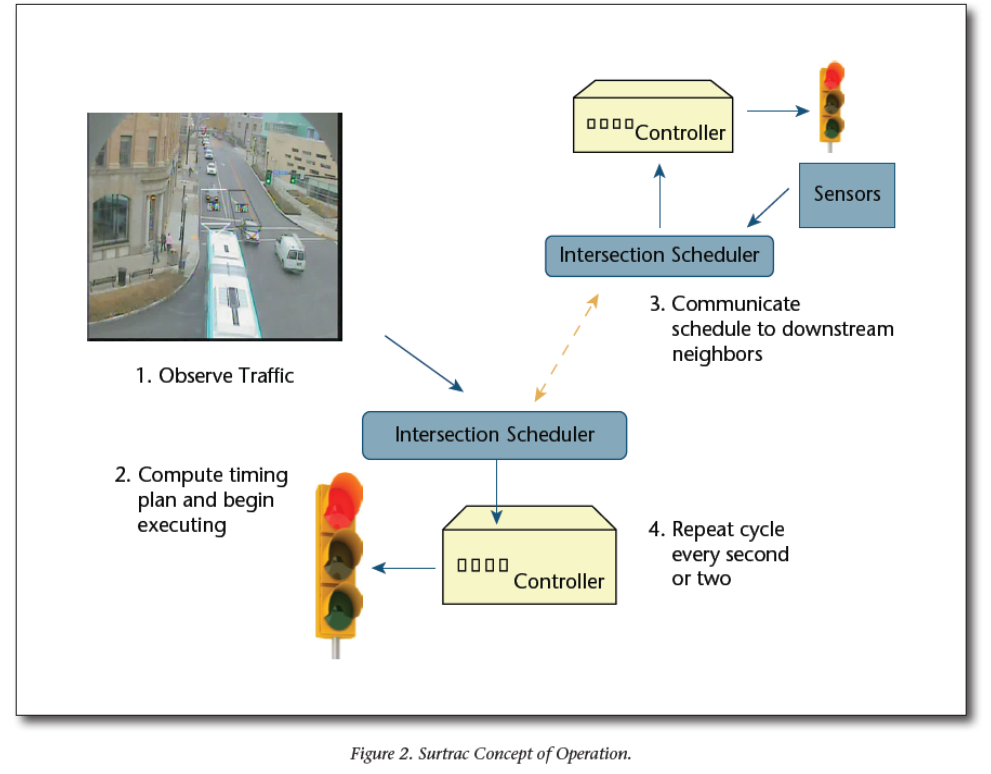
The author´s approach to this problem is embodied in a real-time, adaptive traffic signal system called scalable urban traffic control (Surtrac). Combining principles from automated planning and scheduling, multiagent systems, and traffic theory, Surtrac treats traffic signal control as a decentralized online planning process. In operation, each intersection repeatedly generates and executes (in a rolling horizon fashion) signal-timing plans that optimize the movement of currently sensed approaching traffic through the intersection.

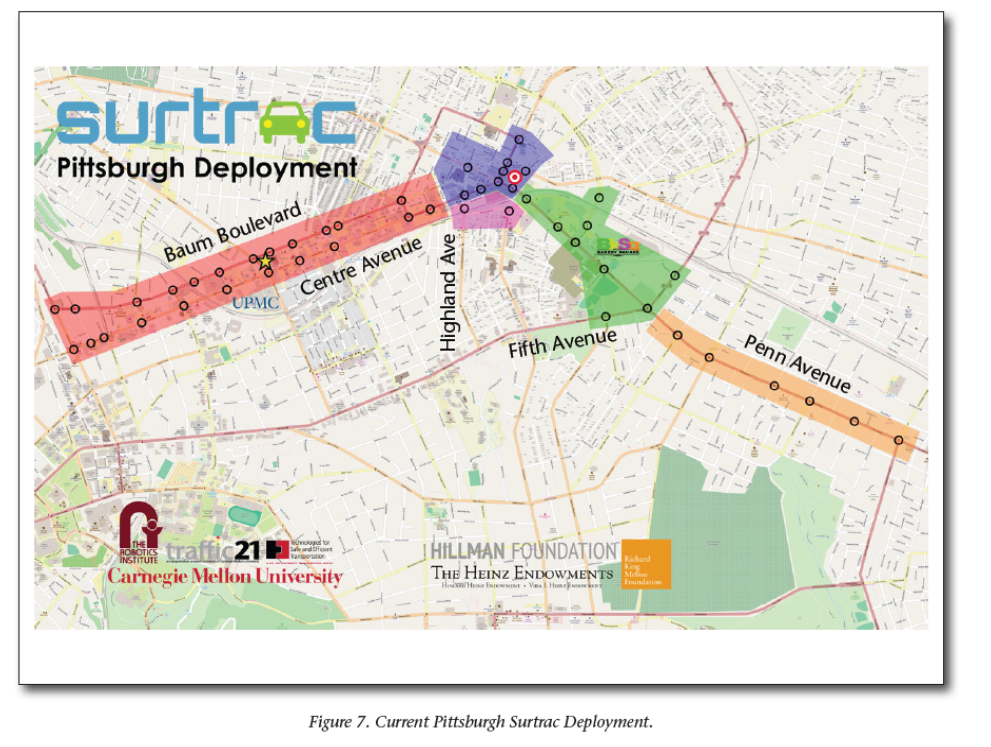
Each time a new plan is produced (nominally every couple of seconds), the intersection communicates to its downstream neighbors what traffic it expects to send their way, allowing intersections to construct longer horizon plans and achieve coordinated behavior. The system is now deployed and operating in several U.S. cities, including Pittsburgh, Pennsylvania; Atlanta, Georgia; More recent work has focused on integrating real-time adaptive signal control with emerging connected vehicle technology, and exploration of the opportunities for enhanced mobility that direct vehicle to-infrastructure (V2I) and pedestrian-to-infrastructure (P2I) communication can provide.

How it works

The research group put a computer running the Surtrac system at every intersection. At the beginning of each planning cycle, each intersection pulls a snapshot of its approaching traffic flows from its local sensors (video cameras, radar, etc.) and develops a predictive model of when traffic in various approaching directions is expected to arrive at the intersection. Based on this predictive model, the system generates, in real time, a signal timing plan that optimizes the movement of approaching traffic through the intersection. Once the timing plan is generated, the system begins to execute it, sending a command to the controller (the hardware device that controls the signals) to either extend the current phase or switch to the next phase.

The system also communicates the traffic it expects to be sending to its downstream neighbors. Downstream intersections are doing the same thing, generating their own local timing plan, but now, in addition to the approaching traffic that they can see through their local sensors, they have an expectation of what traffic is coming down the pike behind them, which allows them to generate a longer horizon plan. Each intersection asynchronously initiates a new planning cycle every second or two.

According to the study there are several basic advantages to this real-time approach to traffic signal control. First and foremost, traffic signals are optimized for the actual traffic on the road at any point in time. Second, the approach is designed for optimization of grids and other complex urban road networks, with suburban corridors being handled as a special case.

Third, the predictive model that is generated can be weighted according to traffic mode (for example, passenger vehicle, bus, pedestrian, bicyclist), and, therefore, Surtrac-generated timing plans can reflect multimodal optimization criteria. Finally, because the system is decentralized, there is no centralized planning bottleneck, and the system is inherently extensible to city scale. Moreover, the system’s decentralized framework also promotes incremental deployment, which allows cities to spread their infrastructure investments over time.

Results: travel times were reduced by over  twenty-five percent, number of stops were reduced by  over thirty percent, and amount of wait time was reduced by forty percent. Although emissions data were not collected, a standard fuel consumption model was applied and showed an estimated reduction of emissions of about twenty percent. Further details of the pilot test can be found in Smith et al. (2012, 2013).

Finally, the research stress that the current technology development efforts center on vehicle route sharing (an equipped vehicle’s willingness to share its route with the infrastructure in order to   reduce uncertainty in the signal system’s predictive model), smart transit priority, safe intersection crossing for pedestrians with disabilities (an app that allows pedestrians with disabilities to directly communicate with signalized intersections and actively  influence traffic control decisions), real-time incident detection, and integrated optimization of signal control  and route-choice decisions.

Commercial Vehicle Show

OCTO is to participate at the “Commercial Vehicle Show”, which takes place in Birmingham​, from 24 to 26 May 2022.

With all the latest vehicles, trailers, equipment, and technology on display, the 2022 Commercial Vehicle Show will be unmissable for thousands of fleet owners, directors, senior managers, and engineers and to anyone running commercial vehicles as part of their business.

OCTO’s Andy Walters will be attending the “Commercial Vehicle Show”.

Don’t miss the opportunity to join us!

Become
a Contributor!
We’re always looking for interesting ideas and content to share within our community.
Get in touch and send your proposal to: press@octotelematics.com