OCTO is to participate at the conference “Connected Car & Mobility: la strada verso una nuova economia” by Digital Innovation Observatories, held on May 27th in Milan.
The conference will be an opportunity to review the Connected Car market in Italy, analysing the main technological innovations, the perspective of companies, Public Administrations and consumers, as well as the impact of the new business models that are transforming smart mobility solutions.
At 11 am CET, Gabriele Natoli, Sharing & Rental Stream Leader at OCTO will be speaking in the panel “Connected Car & Mobility: mercato, servizi e modelli di business”.
OCTO will participate to the “Transpotec Logitec“, that will take place in Milan on the 12th and 15th of May 2022.
Transpotec Logitec is an integrated 360-degree business and content platform for transport and logistics development. A representative offer of all the components of the market. Located in what is now considered the first national logistics center and one of the main hubs with European-world markets (Lombardy), Transpotec Logitec is an international exhibition with a particular focus on Europe, the Mediterranean Basin and the Balkans.
OCTO’sLuciana Chiurino will be attending the “Transpotec Logitec”.
Financing mobility: an overview of European and national programs supporting mobility
As previously described in the first article of this series, “The reference pilots for the development of the “Italian Way to Connected Mobility”: a mapping of more than 160 cases”, the second edition of the initiative “The Italian Way to Connected Mobility” began with the description of use cases in an aim to highlight the main insights and opportunities associated to the development of new cases of smart and connected mobility. To this end, The European House – Ambrosetti has mapped the most successfull use cases to identify the potential applications and benefits of Connected Mobility projects.
Alongside the mapping of the case studies, The European House – Ambrosetti has conducted an in-depth analysis of European Plans to finance the mobility of the future. This goal of this work was to identify where Europe and some benchmark countries (Italy, France, Spain and Germany) are directing public investments for the development of new mobility paradigms. Furthermore, the analysis aims to ascertaining the extent to which connected technologies are being taken into account as innovation levers in the huge investments in mobility and transportation planned both at the national level and by the main European countries.
The present analysis identified the necessary elements enabling the design and implementation of mobility initiatives that involve connected technologies. First, infrastructures capable of acquiring and exchanging data with the external ecosystem are necessary. Second, due to their very nature, connected mobility projects must fall on an “ecosystem” of stakeholders – citizens, companies, public institutions – who voluntarily share their personal data for the optimization of services. For instance, with reference to the management of the transition to electric motorizations, a public transport company can define the route of battery-powered vehicles on the basis of a real-timesurvey of consumption data; Public Administrations can identify optimal areas for charging stations by analyzing route statistics and estimates of residual charge levels; citizens can quickly identify available strales for charging based on their location. Finally, local Government play a crucial role in the promotion of a modern vision of mobility, by guiding citizens during the phases of the process of change. To this end, it is necessary that public and private entities are aware of the potential of connected mobility technologies that can be applied to their area, in order to promote new use-cases that are capable of solving problems otherwise difficult to manage.
Identifying new mobility patterns can galvanize the objectives of the European Commission’s policy document“Sustainable and Smart Mobility Strategy”[1]published in December 2020, which promotes the development of sustainable, smart and resilient mobility projects at the European level by 2050. Notably, the document integrates valuable indications related to several areas that are often analyzed separately, such as the diffusion of private and public zero-emission vehicles, the development of new types of mobility and self-driving vehicles, the diffusion of connected technologies in mobility, etc. This document highlights once more the relevance of Public Institutions in developing and promoting highly innovative visions of mobility projects, both on a national and local scale.
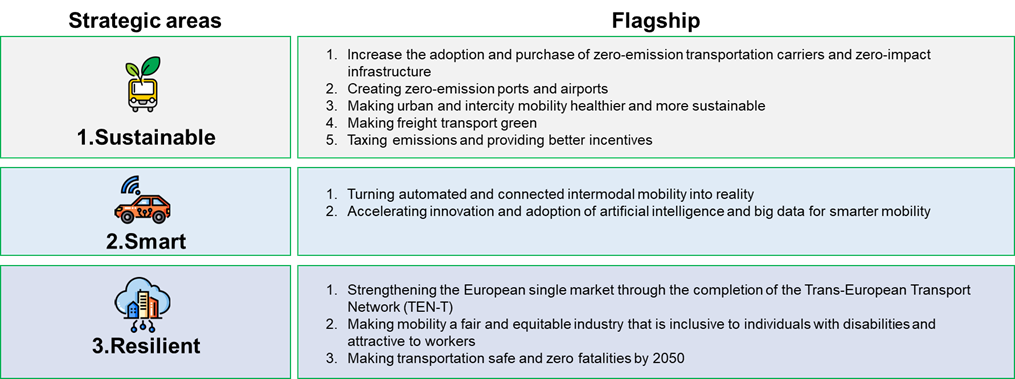
The policy document pointed out that the “twin transition” – digital transition and green transition – has a central role in promoting a reduction in emissions and an improvement in the entire transportation structure.[2] Fostering the transition to digitized models that enable the decarbonization of the transports sector underpins ten ambitious milestones – to be achieved between 2030 and 2050 – ranging from emission neutrality in road transports to the full implementation of trans-European corridors, via the development of autonomous mobility.[3] To ensure the achievement of these milestones, the European Strategy is divided into three strategic areas that are complementary and synergistic with each other: sustainable mobility, smart mobility and resilient mobility. These areas include ten components – “flagships” – thatpoint atinteresting strategies for the digital and ecological transition, but nevertheless lack specific initiatives to implement intermodal and fully integrated mobility models in urban ecosystems.[4]
Figure 1: Articulation of the 10 flagships of the Sustainable and Smart Mobility Strategy. Source: elaboration The European House – Ambrosetti on data from the European Commission, 2022
To achieve the goals set by the Sustainable and Smart Mobility Strategy, the European Commission has deployed a substantial plan of economic and financial aid of 2.018 billion euros, divided mainly between:
1,211 billion euros included in the EU budget for 2021-2027;
807 billion euros set up by the Next Generation EU fund.
Within this plan, the three key programs that encapsulate the main areas of intervention in the European Mobility Strategy are:
Connecting Europe Facility (CEF), €25.8 billion included in the EU budget (2% of the budget) for the period 2021-2027, and broken down into grants aimed at the development of sustainable high-impact infrastructure for the entire EU territory. As of April 2022, the CEF has 3 calls for proposals underway related to the development of intelligent incident detection and warning systems, the development of cross-border renewable energy sharing systems, and the development of alternative fuel supply infrastructure. The Reference Entity for these funds is the European Climate Infrastructure and Environment Executive Agency.[5]
Cohesion Fund (CF)[6] and European Regional Development Fund (ERDF), both part of the €274 billion allocated by the EU budget to regional cohesion (accounting for about 23 percent of the entire budget), devoting €32.5 billion (accounting for 67 percent of the CF) and €192.4 billion (accounting for 85 percent of the ERDF), respectively, to mobility on a regional and urban scale, with the goal of connecting all European regions to the TEN-T network by 2030.[7]
Recovery and Resilience Facility (RRF), acentral part of the Next Generation EU fund, divided into €338 billion of grants and €385.8 billion of loans, for a total of €723.8 billion (accounting for about 90 percent of the Next Generation EU fund), the management of which is entrusted to Member States through the implementation of National Recovery and Resilience Plans (NRPs) – which were the main focus of this analysis due to the amount of allocations specifically dedicated to mobility.
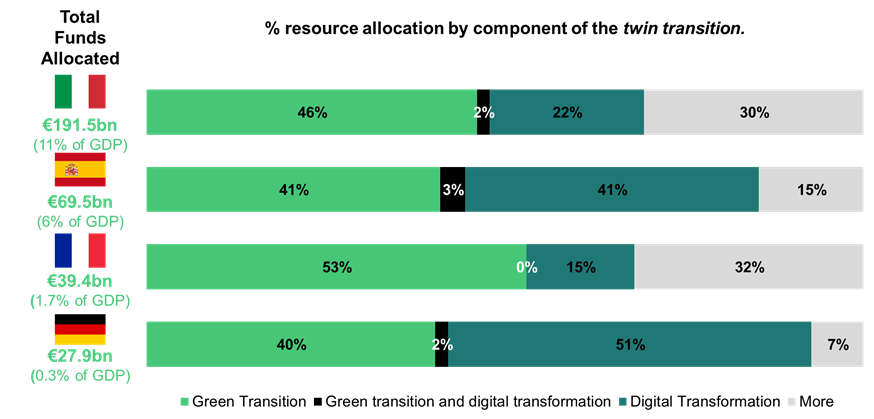
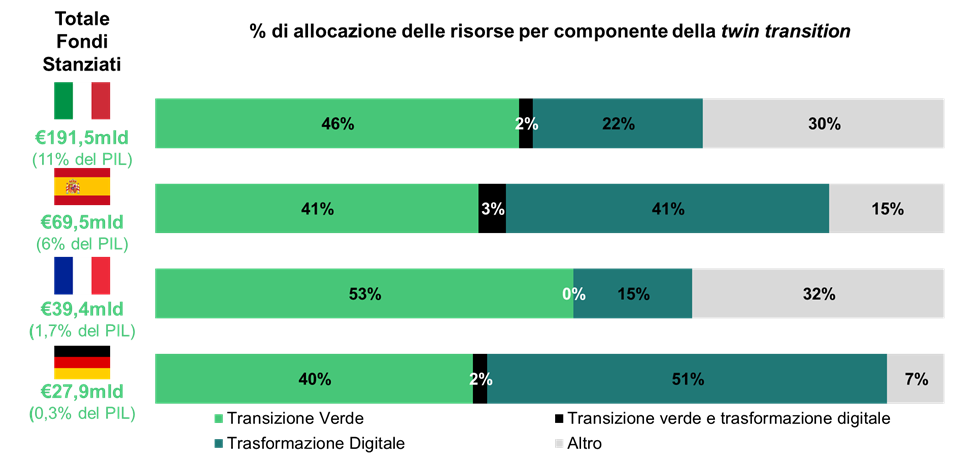
The analysis of the Recovery and Resilience Plans submitted by the main EU countries – Italy, Spain, France and Germany – led to interesting insights regarding the different approaches in the allocation of resources and the management of mobility aspects. In fact, going back to the concept of “twin transition” and the way in which it was implemented in the pilot cases analyzed – that is, through a “green” and a “digital” component operating synergistically – it is quite surprising that, within the NRPs presented by the benchmark countries, the project initiatives where the hybridization of the two components is found accounts for 2-3% of the total resources allocated, with France even choosing not to allocate resources to hybrid projects, and opting instead for investments centered on the green transition of major transport infrastructures: railways, highways and ports.
Figure 2: Percentage allocation of funds by investment components relevant to the “twin transition.” Source: elaboration The European House – Ambrosetti on data from Intesa Sanpaolo and the European Commission, 2022
When compared with other public initiatives, it emerges how this figure reflects precise strategic choices by governments and institutions, that go beyond the use of European funds. In fact, within the initiatives strictly related to mobility (accounting for 20 percent to 30 percent of the total amount of Plans submitted), the issue of connected mobility was often a marginal topic.
Notably, only in few cases the use of connected technologies for mobility been explicitly included as a requirement for project (as in the Spanish PNRR). This exhacerbates the need to increase awareness with respect to the transformative potential of connected technologies, especially among Public Administrations called upon to define projects eligible for funds.
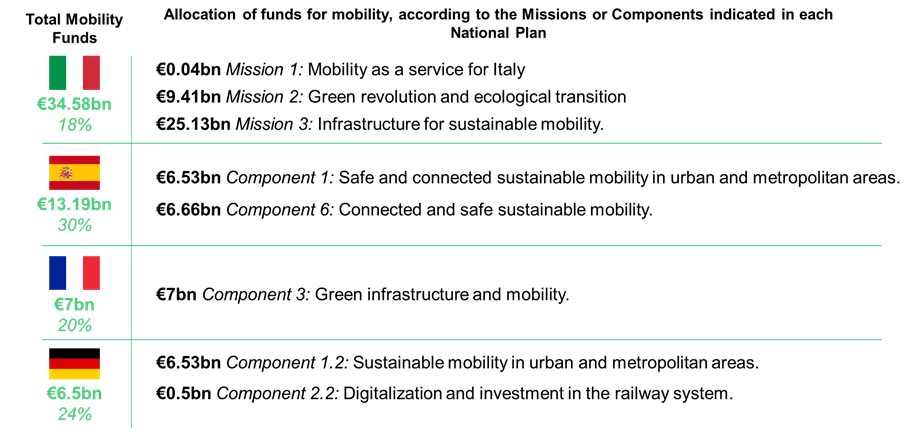
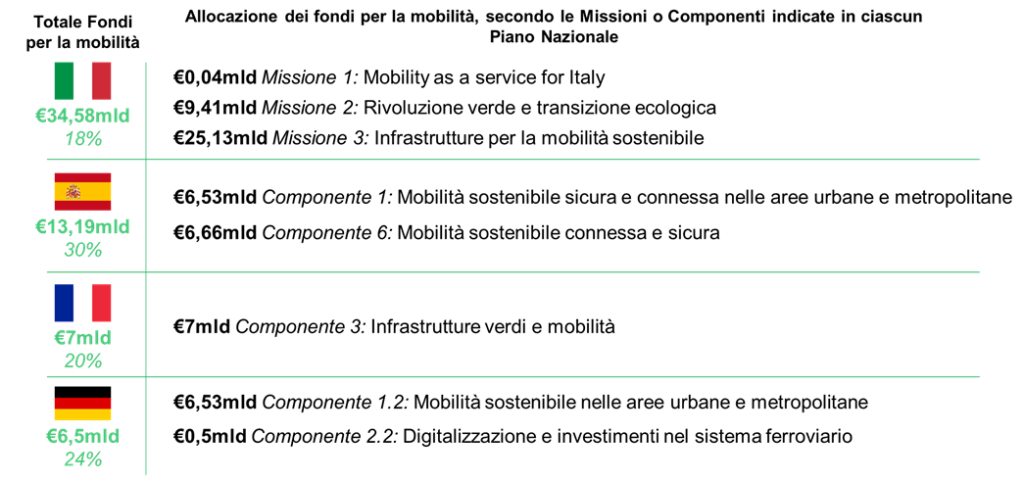
Figure 3: Allocation of mobility-related funds in the various NRPs of the benchmark countries. Source: elaboration The European House – Ambrosetti on national PNRR data, 2022
In this framework, the Italian PNRR differs slightly from its European counterparts, not so much in the allocation of funds for mobility – which is the largest among the countries considered (over 34 billion Euros) – but rather in the fact that Mobility as a Service, is treated in a dedicated investment program, which, however, remains a single item: Investment 1.4.6 “Mobility as a Service for Italy”. The investment, for which the NRP allocates 40 million euros, fits within Mission 1 with the goal of creating a national MaaS infrastructure. The first tranche of funds, 16.9 million euros, was allocated on Oct. 29, 2021 through a call for tenders aimed at identifying three pilot projects – including one in southern Italy – to be implemented in as many technologically advanced metropolitan cities (“leading” cities) as possible, in an aim to introduce the Mobility as a Service paradigm in local transport systems[8]. The profile of the winning cities – Milan (MaaS and Living Lab[9] ), Naples (MaaS) and Rome (MaaS)[10]– suggests that the strategic line adopted by the Ministry for Technological Innovation and Digital Transition is to favor projects to be implemented in large metropolitan contexts. This strategy was again confirmed in the call for proposals published last May 2, 2022, which reiterates the theme of developing pilot projects in already technologically advanced metropolitan contexts.
It is considered important to point out that, in the Call’s understanding, MaaS is limited to the integration of multiple public and private transportation services, accessible to the end user through a single digital channel. Such a view turns out to be limiting with respect to the broader potential of connected mobility, in which data sharing can enable the creation and execution of new types of mobility.
Considering the Italian scenario, in order to make this paradigm effective, the development in the most advanced cities should be combined with regional-scale approaches that take into account the peculiarities of smaller cities and suburban areas. Focusing only on the medium-to-large urban areas limits the possibility of implementing distributed mobility and commuting projects. On the contrary, other European countries such as Spain, a differentiated approach has been adopted for large and small cities, directly entrusting even small to medium-sized local administrations with the definition of projects that can be eligible for PNRR calls.
Finally, connected mobility could take on further relevance within the NRP if it were to be included within other Missions as well, as a prerequisite for the execution of projects related to fleet transition and the strengthening of the transport infrastructure network. For instance, looking again at the Spanish PNRR, within both reference components for mobility development (the 1 and 6), the use of connected technologies is considered as a requirement to be included in the project plans.[11]
Two main components emerge from the analysis of the French Recovery Plan, which includes 7 billion euros to be allocated for national mobility development:
Preponderance of the “green” aspect of the twin transition, to which the NRP devotes about 50 percent of its resources, compared with about 40 percent for its Italian counterpart;
Strong mix of direct investment (taking up slightly less than half of the allocated resources) and tax breaks for private enterprises.
With this in mind, in order to find initiatives in France that could echo what we have seen in Italy and Spain, it is necessary to look beyond the Plan National de Relance et de Résilience, focusing instead on the loi d’orientation des mobilités (Mobility Orientation Law), enacted in 2019 and providing for a total investment of €14.3 billion for the period 2023-2024, with the aim of:
Develop multimodal interchange and public transport hubs, with a priority on serving key urban policy neighborhoods;
support innovations, new mobility services, and autonomous and connected vehicles;
boosting active mobility modes, particularly biking and walking.[12]
Germany has instead preferred not to make use of its Recovery and Resilience Plan for interventions in the area of connected mobility. In fact, the Plan appears to be focused almost solely on supporting the automotive industry in its transition to electric mobility with added specific interventions on the development of hydrogen and the rail system. From this perspective, innovation in local public transport is managed by the governments of the Länder (finding many similarities with both the Spanish case, as well as the French loi d’orientation des mobilités), which are entrusted with the task of drafting local transport plans and the coordination of service operators. The federal government, on the other hand, is given management and authority over major infrastructure and long-distance transports. This strategic approach is also confirmed in the way funds for mobility development are allocated: the 269.6 billion euros allocated by the Federal Transport Infrastructure Plan 2030 (FTIP), sponsored by the Federal Ministry of Transport and Digital Infrastructure, is almost exclusively for the maintenance and upgrading of the road fabric (49.3 percent of funds), and the federal rail system (41.6 percent of the total)[13] .
Similarly, within the 27.9 billion euros of the Deutscher Aufbau und Resilienz plan (DARP), it can be seen that, in line with the priorities drawn up in the federal plan, there is a clear intention to resume the goal of supporting the German automotive industry through incentives and tax relief (covering about 60 percent of the total mobility funds provided in the DARP), while high-innovation-load initiatives in the area of connected mobility fall under the initiative of individual states, among which Hamburg stands out. The latter, thanks to its connected and multimodal mobility policies, ranks as the clear leader in Bitkom’s (the German digital industry association) Smart City Index 2020. Since the launch of Hamburg’s ITS-strategy: Providing Future Urban Mobility and Logistics Solutions, adopted by the Senate in 2016, Hamburg has completed 63 projects in the area of connected mobility. In addition, the City of Hamburg has launched another 95 projects to be developed with investments of €60 million across 7 fields of action[14] .
In conclusion, the excursus, made on public initiatives to support the development of connected mobility within the main European countries, highlighted how the involvement of small to medium-sized urban realities is the key strategy for the development of truly integrated mobility systems.
The main case studies, presented in our previous article “Reference pilots for the development of the “Italian Way to Connected Mobility”: a mapping of more than 160 cases,” highlighted the centrality of public actors in promoting new initiatives with multi-stakeholder involvement, as well as the importance of working at the local level to identify real development needs and opportunities. This logic should be embraced in the implementation phases of the NRP so as to ensure the achievement of the milestones while generating important spillovers throughout the territory.
Finally, it is important for the NRP to provide reward mechanisms for those projects that include the use of connected technologies as a lever to transform mobility toward OCTO’s Vision Zero: zero pollution, zero traffic, and zero accidents.
Author:
The European House – Ambrosetti
[1] Source: EU Mobility Strategy, European Commission, 2022.
[2] Source: elaboration of The European House – Ambrosetti on data from European Commission and European Environment Agency, 2022.
[3] These milestones include: (i) achievement of 30 million operational zero-emission cars on all European roads by 2030; (ii) achievement of energy neutrality in more than 100 cities by 2030; (iii) doubling of high-speed rail traffic by 2030; (iv) achievement of energy neutrality on all commuter routes under 500km by 2030; (v) implementation of large-scale autonomous moblity by 2030; (vi) placing the first 0-emission vessels on the market by 2030; (vii) placing the first 0-emission vehicles on the market by 2035; (viii) full achievement of green transition in the automotive sector by 2050; (ix) doubling of European rail mobility by 2050; and (x) full implementation of the Trans-European Transport Network (TEN-T) by 2050. Source: elaboration The European House – Ambrosetti on European Commission data, 2022.
[4] Source: elaboration of The European House – Ambrosetti on Deutsche Gesellschaft fur Internazionale Zusammenarbeit, 2022.
[5] Source: elaboration The European House – Ambrosetti on European Commission data, 2022.
[6] For the Cohesion Fund, the European Commission’s implementing decision establishes the following member states as beneficiaries of the Cohesion Fund: Bulgaria Czechia Estonia Greece Croatia Cyprus Latvia Lithuania Hungary Malta Poland Portugal Romania Slovenia and Slovakia. As for Italy, the beneficiary regions are: Umbria Marche Abruzzo Campania Puglia Basilicata Calabria Sicily and Sardinia. Source: elaboration The European House – Ambrosetti on EUR-Lex data, 2022.
[7] Source: elaboration The European House – Ambrosetti on European Commission data, 2022.
[8] Source: elaboration The European House – Ambrosetti on data from Ministry for Technological Innovation and Digital Transition, 2022.
[9] According to the definition given by the Ministry for Technological Innovation and Digital Transition, Living Lab means “an urban laboratory where innovations and emerging technologies in the field of mobility can be tested under real conditions, in co-creation with users.” Source: elaboration The European House – Ambrosetti on data from Ministry for Innovation and Digital Transition, 2022.
[10] Ibid.
[11] Source: elaboration The European House – Ambrosetti on data Ministerio de Trasnportes Movilidad y Agenda Urbana, 2022.
[12] Source: elaboration The European House – Ambrosetti on Legifrance data, 2022
[13] Source: elaboration The European House. – Ambrosetti on data from Federal Ministry of Transport and Digital Infrastructure, 2022.
[14] The 7 fields of action are: Data and Information Collection (e.g., Urban Data Platform Hamburg); Automated Traffic Counting with Thermal Imaging Cameras; Intelligent Traffic Control and Guidance; Intelligent Infrastructure (Hamburg Box); Intelligent Parking (SynCoPark); Mobility as a Service (HVVV Switch, on-demand shuttles); Automated and Networked Driving (HEAT).
Financing mobility: uno sguardo di insieme sui programmi europei e nazionali a supporto della mobilità
Come già descritto nel primo articolo di questa serie, “I pilot di riferimento per lo sviluppo della “Via italiana alla mobilità connessa”: una mappatura di oltre 160 casi”, i lavori della seconda edizione dell’iniziativa, la “Via italiana alla mobilità connessa” sono iniziati con una serie di approfondimenti concreti volti a dimostrare le opportunità legate allo sviluppo di nuove forme di mobilità smart e connessa. A tal fine, The European House – Ambrosetti ha mappato i principali casi di successo a livello internazionale che hanno permesso di identificare modelli di sviluppo, applicazioni e benefici concreti della Connected Mobility.
Alla mappatura dei casi studio The European House – Ambrosetti ha affiancato un’approfondita analisi circa i piani europei di finanziamento della mobilità del futuro. Tale lavoro è stato svolto con l’obiettivo di identificare le direzioni verso cui l’Europa e alcuni Paesi benchmark (Italia, Francia, Spagna e Germania) stanno indirizzando gli investimenti per lo sviluppo di nuovi paradigmi di mobilità. In seconda istanza, l’attività è volta a verificare in quale misura le tecnologie connesse siano prese in considerazione quali leve di innovazione negli ingenti investimenti in mobilità e trasporti previsti sia a livello nazionale sia dai principali paesi europei.
Queste analisi aiutano a mettere a fuoco alcuni elementi abilitanti che si rendono necessari nel progettare e realizzare iniziative di mobilità che prevedano l’uso di tecnologie connesse. In primo luogo, è necessario prevedere la dotazione di infrastrutture in grado di acquisire e scambiare dati con l’ecosistema esterno. In secondo luogo, i progetti di mobilità connessa, per loro natura, si devono calare su un “ecosistema” di stakeholder – cittadini, aziende, enti pubblici – che decidono di acquisire e, all’occorrenza, scambiare dati e servizi digitali per l’ottimizzazione delle proprie attività. Ad esempio, con riferimento alla gestione della transizione verso motorizzazioni elettriche, un’azienda di trasporto pubblico può definire le corse dei mezzi a batteria sulla base di una rilevazione in real-time dei dati di consumo; una Pubblica Amministrazione può individuare le aree ottimali per stazioni di ricarica analizzando le statistiche sui tragitti e le stime sui livelli di carica residua; un cittadino può individuare velocemente gli stralli disponibili per la ricarica. Infine, l’attività delle Pubbliche Amministrazioni locali è fondamentale per promuovere una visione moderna di mobilità accompagnando il cittadino nel processo di cambiamento. In tal senso, è imprescindibile che i diversi Enti conoscano le potenzialità delle tecnologie di mobilità connessa al fine di promuovere nuovi use-case da applicare nei propri contesti ed in grado di risolvere problematiche altrimenti difficili da gestire.
Più ad ampio spettro, la definizione di nuovi modelli di mobilità può fare leva sugli obiettivi che la Commissione Europea si è data nell’ambito del documento programmatico “Sustainable and Smart Mobility Strategy”[1], pubblicato a dicembre 2020, con l’obiettivo di promuovere lo sviluppo di una mobilità sostenibile, smart e resiliente a livello europeo entro il 2050. In particolare, il documento integra in una visione unitaria indicazioni preziose rispetto a diversi aspetti spesso analizzati in modalità disgiunta, quali la diffusione di veicoli privati e pubblici a zero emissioni, lo sviluppo di nuove forme di mobilità, la messa in circolazione di veicoli a guida autonoma, la diffusione di tecnologie connesse in ambito mobilità, ecc. Da questo documento, emerge con ancora maggior forza l’importanza dell’attore pubblico nello sviluppare e promuovere visioni di sviluppo della mobilità fortemente innovative anche a livello locale.
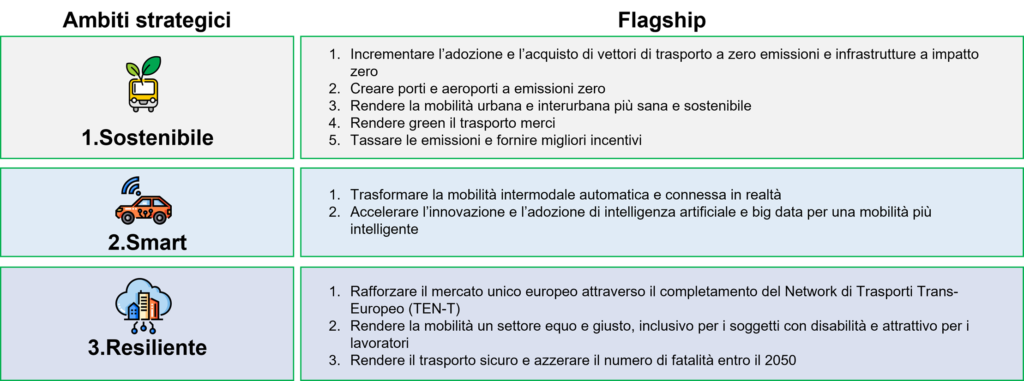
All’interno di tale documento si è osservato come la “twin transition” – nelle sue componenti transizione digitale e transizione verde – rivesta un ruolo centrale nel promuovere una riduzione delle emissioni e un miglioramento dell’intera struttura dei trasporti[2]. Favorire la transizione su modelli digitalizzati che permettano la decarbonizzazione dell’industria dei trasporti sta alla base di dieci ambiziose milestone – da raggiungere tra il 2030 e il 2050 – che vanno dal conseguimento della neutralità delle emissioni nel trasporto su strada fino alla piena realizzazione di corridoi transeuropei, passando per il completo sviluppo della mobilità autonoma[3]. Per garantire il raggiungimento di tali milestone, la Strategia europea si articola in dieci aree di intervento attorno a tre ambiti strategici tra loro complementari e sinergici: mobilità sostenibile, mobilità intelligente e mobilità resiliente. Queste aree – chiamate “flagship” – mostrano interessanti strategie di digitalizzazione e di supporto alla transizione ecologica, ma tuttavia mancano di iniziative incisive per la realizzazione di modelli di mobilità intermodali e pienamente integrate negli ecosistemi urbani[4].
Figura 1 Articolazione delle 10 flagship della Sustainable and Smart Mobility Strategy. Fonte: elaborazione The European House – Ambrosetti su dati della Commissione Europea, 2022
Per il raggiungimento degli obiettivi posti dalla “Sustainable and Smart Mobility Strategy”, la Commissione Europea ha messo in campo un piano consistente di aiuti economici e finanziari da 2.018 miliardi di Euro, divisi principalmente tra:
1.211 miliardi di Euro costituiti dal budget UE per il periodo 2021-2027;
807 miliardi di Euro costituiti dal fondo Next Generation EU.
All’interno di questo piano, i tre programmi chiave che racchiudono le principali aree di intervento previste dalla Strategia europea per la mobilità sono:
Connecting Europe Facility (CEF) – 25,8 miliardi di Euro inclusi nel budget UE (pari al 2% del totale) per il periodo 2021-2027, e articolati in contributi a fondo perduto destinati allo sviluppo di infrastrutture sostenibili ad alto impatto per tutto il territorio dell’UE. Ad aprile 2022, la CEF ha in corso di svolgimento 3 call for proposal centrate su sviluppo di sistemi intelligenti di rilevazione e allerta incidenti, sviluppo di sistemi transfrontalieri di condivisione delle fonti energetiche rinnovabili e sviluppo di infrastrutture alternative di fornitura dei combustibili alternativi. L’Ente di riferimento di questi fondi è la European Climate Infrastructure and Environment Executive Agency[5].
Fondo di Coesione (CF)[6] e Fondo Europeo di Sviluppo Regionale (ERDF) – inclusi entrambi all’interno dei 274 miliardi di Euro che il budget UE stanzia per la coesione regionale (pari a circa il 23% dell’intero budget), destinando rispettivamente 32,5 miliardi di Euro (pari al 67% del CF) e 192,4 miliardi di Euro (pari al 85% del ERDF) alla mobilità su scala regionale ed urbana, con l’obiettivo di connettere tutte le regioni europee al network TEN-T entro il 2030[7].
Recovery and Resilience Facility (RRF), parte centrale del fondo Next Generation EU, suddiviso in stanziamenti pari a 338 miliardi di Euro di finanziamenti a fondo perduto e 385,8 miliardi di Euro di prestiti, per un totale di 723,8 miliardi di Euro (pari circa al 90% del fondo Next Generation EU), la cui gestione è affidata agli Stati Membri attraverso la realizzazione di Piani Nazionali di Ripresa e Resilienza (PNRR), che sono stati l’oggetto principale di questa analisi grazie alla presenza importante di stanziamenti specificamente dedicati alla mobilità.
Partendo dunque dall’analisi dei Piani di Ripresa e Resilienza, presentati dai principali Paesi della UE – Italia, Spagna, Francia e Germania – sono stati rilevati spunti di riflessione interessanti per quanto concerne l’allocazione delle risorse e la gestione degli aspetti relativi alla mobilità nei diversi contesti nazionali. Riprendendo infatti il concetto di “twin transition” e il modo in cui questa transizione è stata implementata nei casi pilota analizzati – ossia attraverso una componente “green” e una “digital” che operano in maniera sinergica – appare sorprendente che, all’interno dei PNRR presentati dai Paesi benchmark, le iniziative progettuali in cui si ritrova un’effettiva ibridazione di entrambe le componentiammontino solamente al 2-3% delle risorse totali stanziate, con la Francia che addirittura sceglie di non allocare risorse in questo senso, preferendo investimenti centrati sulla transizione verde delle grandi infrastrutture di trasporto: ferrovie, autostrade e porti.
Figura 2: Allocazione percentuale dei fondi in base alle componenti di investimento rilevanti per la “twin transition”. Fonte: elaborazione The European House – Ambrosetti su dati Intesa Sanpaolo e Commissione Europea, 2022
Se paragonato ad altre iniziative pubbliche, emerge come questo dato rispecchi precise scelte strategiche di Governi e Istituzioni, spesso tramite un coinvolgimento che va al di là dell’utilizzo dei fondi europei. Infatti, all’interno delle iniziative strettamente legate alla mobilità (per cui sono state allocate risorse pari a circa il 20% – 30% del totale dei Piani presentati), è stato rilevato come il tema della mobilità connessa sia stato trattato in maniera marginale.
In particolare, solo in alcuni casi il ricorso alle tecnologie connesse per la mobilità è stato esplicitamente previsto come vincolo all’interno di ampi contesti progettuali (come nel PNRR spagnolo). Questo aspetto induce a riflettere ulteriormente sulla necessità di promuovere una awareness ampia rispetto al potenziale trasformativo delle tecnologie connesse, soprattutto tra quelle Pubbliche Amministrazioni chiamate a definire i progetti candidabili ai fondi.
Figura 3: Allocazione dei fondi legati alla mobilità nei vari PNRR dei paesi benchmark. Fonte: elaborazione The European House – Ambrosetti su dati PNRR nazionali, 2022
All’interno di questo contesto, Il PNRR Italiano si discosta leggermente dagli omologhi europei, non tanto per l’allocazione dei fondi destinati alla mobilità – i quali, con oltre 34 miliardi di Euro, sono i più consistenti tra i Paesi considerati – quanto invece per il fatto che il tema Mobility as a Service,viene trattato in un programma di investimenti dedicato, il quale però rimane un’unica voce: Investimento 1.4.6 “Mobility as a Service for Italy”. L’investimento, per cui il PNRR stanzia 40 milioni di Euro, si inserisce all’interno della Missione 1 con l’obiettivo di creare un’infrastruttura nazionale MaaS. La prima tranche di fondi, 16,9 milioni di Euro, è stata assegnata il 29 ottobre 2021 tramite un bando di gara avente per oggetto l’individuazione di tre progetti pilota – di cui uno nel Mezzogiorno – da realizzare in altrettante città metropolitane tecnologicamente avanzate (città “leader”) con l’obiettivo di introdurre, nel contesto dei sistemi di trasporto locale, il paradigma Mobility as a Service[8]. Il profilo delle città aggiudicatarie – Milano (MaaS e Living Lab[9]), Napoli (MaaS) e Roma (MaaS)[10] – lascia intendere come la linea strategica adottata dal Ministero per l’Innovazione Tecnologica e la Transizione Digitale sia quella di prediligere progetti da realizzare in grandi contesti metropolitani. Questa strategia è stata nuovamente confermata nel bando pubblicato lo scorso 2 maggio 2022 che, sempre con una dotazione di 16,9 milioni di Euro, ripropone il tema dello sviluppo di progetti pilota in contesti metropolitani già tecnologicamente avanzati.
Si ritiene importante sottolineare che, nell’accezione del Bando, il MaaS viene limitato alla sola integrazione di molteplici servizi di trasporto pubblico e privato, accessibili all’utente finale attraverso un unico canale digitale. Una tale visione risulta essere limitativa rispetto alle più ampie potenzialità della mobilità connessa, in cui la condivisione dei dati secondo una logica ecosistemica può abilitare non tanto nuove logiche per l’uso dei servizi, quanto piuttosto il concepimento e l’esercizio di nuove forme di mobilità.
Inoltre, nella nostra visione e alla luce della realtà italiana, per una messa a terra efficace di questo paradigma occorre saper coniugare lo sviluppo nelle città più avanzate con approcci a scala regionale che tengano in considerazione le caratteristiche delle città minori e dei territori di periferia. Individuare nelle sole realtà urbane medio-grandi i principali soggetti attuatori, vuol dire, difatti, limitare la possibilità di implementare una progettualità di mobilità connessa più capillare sul territorio, così da favorire la mobilità distribuita e gli spostamenti pendolari. Al contrario, in altri ambiti europei quali la Spagna, si è adottato un approccio differenziato per i grandi centri e le realtà minori, affidando direttamente alle Amministrazioni locali anche di medie-piccole dimensioni la definizione di progetti candidabili ai bandi PNRR.
Infine, il tema della mobilità connessa potrebbe assumere ulteriore rilevanza all’interno del PNRR qualora si ampliasse una sua presenza anche all’interno delle altre Missioni, quale requisito essenziale per la messa a terra di progettualità legate alla transizione delle flotte e al potenziamento della rete infrastrutturale dei trasporti. Ad esempio, sempre guardando al PNRR spagnolo, all’interno di entrambe le componenti di riferimento per lo sviluppo della mobilità (la 1 e la 6), l’utilizzo di tecnologie connesse viene considerato come requisito da includere nelle progettualità[11].
Dall’analisi del Piano di Recupero francese, che prevede 7 miliardi di Euro da destinare allo sviluppo della mobilità nazionale, emergono due componenti principali:
Preponderanza dell’aspetto “green” della twin transition, a cui il PNRR dedica circa il 50% delle risorse, a fronte di un 40% circa dell’omologo italiano;
Forte mix di investimenti diretti (che occupano poco meno della metà delle risorse stanziate) e sgravi fiscali alle imprese private.
In questa logica, per ritrovare in Francia iniziative che possano riprendere quanto visto in Italia e in Spagna, si è dovuto guardare al di là del Plan National de Relance et de Résilience, puntando invece sulla loi d’orientation des mobilités (Legge sull’orientamento della mobilità), emanata nel 2019 e che prevede un investimento totale di 14,3 miliardi di Euro per il periodo 2023-2024, oltre alla cessione quasi completa alle comunità locali al di sotto delle Regioni dell’autorità in materia di mobilità locale, con l’obiettivo di:
sviluppare hub di scambio multimodali e di trasporto pubblico, con una priorità al servizio dei quartieri chiave per la politica urbana;
sostenere innovazioni, nuovi servizi di mobilità e veicoli autonomi e connessi;
dare impulso a modalità di mobilità attiva, in particolare la bicicletta e la camminata.[12]
Infine, analizzando il caso tedesco, si rileva come la Germania abbia preferito non avvalersi del proprio Piano di Recupero e di Resilienza per interventi in materia di mobilità connessa. Il Piano risulta infatti concentrato quasi unicamente sul sostegno all’industria dell’automotive nel suo passaggio alla mobilità elettrica con aggiunte di interventi specifici sullo sviluppo dell’idrogeno e del sistema ferroviario. In quest’ottica, l’innovazione nel trasporto pubblico locale appare essere materia a esclusiva competenza dei governi dei Länder (ritrovando molte similitudini sia con il caso spagnolo, così come con la loi d’orientation des mobilités francese), ai quali viene affidato il compito di redigere i piani di trasporto locale, così come l’autorità nel coordinamento degli operatori del servizio. Al Governo Federale viene invece affidata la gestione e l’autorità sulle grandi infrastrutture e sul trasporto a lunga distanza. Questo approccio strategico trova conferme anche nelle modalità di stanziamento dei fondi per lo sviluppo della mobilità: i 269,6 miliardi di Euro stanziati dal Piano Federale per l’Infrastruttura dei Trasporti 2030 (FTIP), promosso dal Ministero federale dei trasporti e dell’infrastruttura digitale, sono quasi esclusivamente destinati alla manutenzione e al potenziamento del tessuto stradale (49,3% dei fondi), e del sistema ferroviario (41,6% del totale) federale[13].
Allo stesso modo, all’interno dei 27,9 miliardi di Euro del Deutscher Aufbau und Resilienz plan (DARP) si nota come, in linea con le priorità stilate nel piano federale, si voglia riprendere chiaramente l’obiettivo di sostenere l’industria dell’automotive tedesca tramite incentivi e sgravi fiscali (che coprono circa il 60% del totale dei fondi alla mobilità previsti nel DARP), mentre iniziative ad alto carico di innovazione in tema di mobilità connessa cadono sotto l’iniziativa dei singoli Länder, tra cui spicca Amburgo. Quest’ultima, grazie alle sue politiche in tema di mobilità connessa e multimodale, si posiziona come leader assoluto nello Smart City Index 2020 di Bitkom (l’associazione dell’industria digitale tedesca). A partire dal lancio della Hamburg’s ITS-strategy: Providing Future Urban Mobility and Logistics Solutions, adottata dal Senato nel 2016, Amburgo ha completato 63 progetti in ambito di mobilità connessa. Inoltre, la Città di Amburgo ha lanciato altri 95 progetti che saranno sviluppati con investimenti per 60 milioni di Euro su 7 campi d’azione[14].
In conclusione, l’excursus, fatto sulle iniziative pubbliche a sostegno dello sviluppo della mobilità connessa all’interno dei principali Paesi europei, ha evidenziato come il coinvolgimento delle realtà urbane di medio-piccole dimensioni sia la strategia fondamentale per lo sviluppo di sistemi realmente integrati di mobilità.
I principali casi studio, presentati nel nostro precedente articolo “I pilot di riferimento per lo sviluppo della “Via italiana alla mobilità connessa”: una mappatura di oltre 160 casi”, hanno messo in evidenza la centralità degli attori pubblici nel promuovere nuove iniziative con il coinvolgimento di più stakeholder, nonché l’importanza di lavorare a livello locale per identificare le reali necessità e opportunità di sviluppo. Questa logica dovrebbe essere abbracciata nelle fasi implementative del PNRR in modo da garantire il raggiungimento delle milestone temporali e, al tempo stesso, generare ricadute importanti su tutto il territorio.
Infine, riteniamo importante che il PNRR preveda meccanismi premianti per quei progetti che includono l’utilizzo di tecnologie connesse come leva di trasformazione della mobilità verso la Vision Zero di OCTO: zero inquinamento, zero traffico e zero incidenti.
Autore:
The European House – Ambrosetti
[1] Fonte: EU Mobility Strategy, Commissione Europea, 2022.
[2] Fonte: elaborazione The European House – Ambrosetti su dati Commissione Europea e Agenzia Europea per l’Ambiente, 2022.
[3] Tali milestone includono: i) raggiungimento entro il 2030 di quota 30 milioni di autovetture a zero emissioni operative su tutte le strade europee; ii) raggiungimento entro il 2030 della neutralità energetica in oltre 100 città; iii) raddoppio del traffico ad alta velocità su rotaia entro il 2030; iv) raggiungimento della neutralità energetica su tutto le tratte pendolari al di sotto dei 500km entro il 2030; v) implementazione della moblità autonoma su larga scala entro il 2030; vi) immissione nel mercato dei primi battelli a emissioni 0 entro il 2030; vii) immissione nel mercato dei primi veivoli a emissioni 0 entro il 2035; viii) completo raggiungimento della transizione ecologica nel comparto automobilistico entro il 2050; ix) raddoppio della mobilità europea su rotaia entro il 2050; x) completa realizzazione del Network Trans-Europeo dei Trasporti (TEN-T) entro il 2050. Fonte: elaborazione The European House – Ambrosetti su dati Commissione Europea, 2022.
[4] Fonte: elaborazione The European House – Ambrosetti su Deutsche Gesellschaft fur Internazionale Zusammenarbeit, 2022.
[5] Fonte: elaborazione The European House – Ambrosetti su dati Commissione Europea, 2022.
[6] Fonte: Rielaborazione The European House – Ambrosetti su dati Stratio, 2022.Per il Fondo di Coesione, la decisione di esecuzione della Commissione Europea stabilisce i seguenti stati membri come beneficiari del Fondo di Coesione: Bulgaria Cechia Estonia Grecia Croazia Cipro Lettonia Lituania Ungheria Malta Polonia Portogallo Romania Slovenia e Slovacchia. Per quanto riguarda l’Italia, le regioni beneficiarie sono: Umbria Marche Abruzzo Campania Puglia Basilicata Calabria Sicilia e Sardegna. Fonte: elaborazione The European House – Ambrosetti su dati EUR-Lex, 2022.
[7] Fonte: elaborazione The European House – Ambrosetti su dati Commissione Europea, 2022.
[8] Fonte: elaborazione The European House – Ambrosetti su dati Ministero per l’innovazione tecnologica e la transizione digitale, 2022.
[9] Stando alla definizione data dal Ministero per l’innovazione tecnologica e la transizione digitale, per Living Lab si intende “un laboratorio urbano dove sperimentare, in condizioni reali, innovazioni e tecnologie emergenti nel settore della mobilità, in co-creazione con gli utenti”. Fonte: elaborazione The European House – Ambrosetti su dati Ministero per l’innovazione e la transizione digitale, 2022.
[10] Ibid.
[11] Fonte: elaborazione The European House – Ambrosetti su dati Ministerio de Trasnportes Movilidad y Agenda Urbana, 2022.
[12] Fonte: elaborazione The European House – Ambrosetti su dati Legifrance, 2022.
[13] Fonte: elaborazione The European House. – Ambrosetti su dati Ministero federale dei trasporti e dell’infrastruttura digitale, 2022.
[14] I 7 campi d’azione sono: Raccolta dati e informazioni (per esempio, Urban Data Platform Hamburg); Conteggio automatizzato del traffico con telecamere a immagini termiche; Controllo e guida intelligente del traffico; Infrastruttura intelligente (Hamburg Box); Parcheggio intelligente (SynCoPark); Mobilità come servizio (HVV Switch, navette su richiesta); Guida automatizzata e in rete (HEAT).
OCTO will participate to the “Automotive Dealer Day“, that will take place in Verona on the 17th and 19th of May 2022.
“Automotive Dealer Day” is the reference event for the Automotive Ecosystem. It is built on three fundamental pillars that allow participants to live a complete experience: keep up to date on new market trends and learn more about the consequences these will have on the automotive world, by participating in the planned sessions; discover innovative products and services with which to improve processes within your company, by visiting the stands in the Business Area; experience informal networking moments to solidifyor expand your business relationships, by participating in the meetings.
Gabriele Natoli, Sharing & Rental Stream Leader at OCTO will be attending the “Automotive Dealer Day”
OCTO Fleet Essentials helps to reduce crashes and fuel consumption up to 20% while gaining up to 25% savings on maintenance costs through efficient interaction with mobile assets.
Rome 4th May 2022 – OCTO Telematics – a leading provider of telematics services and advanced data analytics for the insurance industry, fleet telematics and smart mobility – announced today the availability of OCTO Fleet Essentials, an innovative and smart digital solution to improve fleet efficiency, safety, costs and overall sustainability easily and quickly.
Both private and public transport sectors today are increasingly coping with the issues of a fast-changing urban mobility landscape. Managers of corporate, short renting and long lease fleets must optimize their fleets in terms of fuel consumption, maintenance, insurance costs and vehicle uptime to remain competitive and profitable.
More than just a digital platform, OCTO Fleet Essentials provides quick and easy access via web, smartphone, and tablet to provide a detailed view of mobile assets’ status and performance to fleet managers.
OCTO Fleet Essentials solution includes:
– Scheduled Reports to access accurate data regularly and manage driving hours, fuel usage, workforce time and business exceptions.
– Event-based Alerts to respond promptly to critical instances that impact the business, such as geofencing, vehicle diagnostic alerts, crashes.
– DriveAbility® Advanced Scoring to monitor Fleet Driver driving habits and behaviours. This market leading highly predictive risk score allows negotiation of better insurance rates.
– Scheduled Maintenance reminders manage timely Service events, to reduce unexpected downtime and optimise fleet vehicle health.
– Diagnostics to monitor the vehicle health status for a prompt reaction to diagnostic alerts.
– Accident and Crash Reporting to receive prompt accident notification to provide timely driver support as well as automatically collect relevant data to accelerate claim management and reduce fraud.
OCTO Fleet Essentials supports all fleet stakeholders while easily, conveniently, and safely managing fleets, regardless of vehicle manufacturer or fleet size.
About OCTO
OCTO has always been at the forefront of innovation in the connected mobility sector. A pioneer in insurance telematics, today the company is the main advanced telematics and technology solutions provider also in the Fleet Management and Smart Mobility industries, leveraging on Machine Learning and AI to transform IoT data into actionable intelligence.
Thanks to its know-how, the expertise developed in 20 years of global advanced analytical services, and its M&A strategy, OCTO is spreading the value of advanced data analytics through its scalable platform to serve worldwide end users of different mobility applications with a superior customer experience.
Through different business applications and use cases, OCTO is bringing telematics at the core of the smart cities as advocate of the global goals of sustainability thanks to OCTO Vision Zero: Zero Crashes, Zero Congestion, Zero Pollution.
OCTO has currently 5,5 million connected users, holds the largest global database of telematics data, with more than 510B KM of driving data collected and over 501,000 crashes and insurance events analyzed, and an operational management capacity of over 400.000 hires per month. www.octotelematics.com
OCTO is to participate at the ITT Hub, which takes place in Farnborough, on the 11th and 12th of May 2022.
The ITT Hub is the annual meeting place for the commercial road transport sector, bringing together the latest innovation and technology for bus, coach, truck, van, last mile and autonomous vehicle fleets.
OCTO’s Andy Walters will be attending the ITT Hub.
Don’t miss the opportunity to join us!
Become a Contributor!
We’re always looking for interesting ideas and content to share within our community. Get in touch and send your proposal to: press@octotelematics.com
Your privacy
This site uses cookies or similar technologies of a technical nature, including from third parties (to allow the website to function correctly and smoothly), and, with your consent, also profiling (to send advertising messages in line with your preferences expressed in the context of web browsing and/or to analyze the behavior of visitors to the site), as specified in the Cookie policy. You can manage your preferences using the 'Cookies Settings' button. We remind you that clicking on 'Reject all cookies' or closing the banner using the appropriate X, involves the persistence of default settings, and therefore you will continue to navigate in the absence of cookies other than technical ones.
Privacy Preference Center
General information
When you visit any website, it may store information on your browser, mostly in the form of cookies. This information might be about the site navigation, your preferences or data relating to the device used. Some of these cookies are used to provide you with a better browsing experience and allow you some features (Navigation or session cookies, Functionality cookies, Analytics cookies), others to send you personalized advertisements (Profiling cookies). You can choose not to allow the installation of cookies - net of the technical ones necessary for the functioning of the Site - by clicking on the headings of the relevant categories to find out more and change the settings using the "ACTIVE/INACTIVE" slider. However, disabling certain types of cookies may limit your browsing experience on the Site and the services we can offer. Octo informs users that the different types of cookies used have a persistent duration until the cookie configuration settings are changed.
Technical Cookies
Always on
The technical cookies used by Octo are necessary for the functioning of this Site. This type of cookie is used in response to user requests for services, such as authentication to access restricted areas or filling in forms. These cookies ensure the normal navigation and use of the Site. You can set the browser used for navigation to block these cookies, but some sections of the Site may not work.
Octo telematics
pll_language - www.octotelematics.com
The cookie stores the language code of the last page visited. (duration: 1 year)
PHPSESSID - www.octotelematics.com
The cookie is used to store and identify a user's unique session ID for the purpose of managing the user's session on the website. The cookie is a session cookie and is deleted when you close all browser windows. (duration: Session)
YouTube
VISITOR_INFO1_LIVE - *.youtube.com
Used to track the information of YouTube videos embedded on a website. (duration: 5 months and 27 days)
CONSENT - *.youtube.com
(duration: 16 year and 8 months)
YSC - *.youtube.com
It is used to track the views of embedded videos. (duration: Session)
Analytics Cookies
Octo uses analytics services to understand the level of effectiveness of the content, the interests of users and to improve the functioning of this Site.
Google
test_cookie - *.doubleclick.net
The purpose of the cookie is to determine whether the user's browser supports cookies. (duration: 15 minutes)
IDE - *.doubleclick.net
It stores information about how the user uses the website and any other advertisements before visiting the website. It is used to present users with advertisements that are relevant to them based on their user profile. (duration: 1 year and 24 days)
Profiling Cookies
This Site uses Profiling cookies to send targeted advertising to users, that is in line with their preferences expressed during navigation. In particular, these types of cookies are installed by third parties, advertising partners of Octo Telematics S.p.A. who may present, also on other sites, ads and advertising content based on the interests shown. The installation and use of these cookies requires the user's consent.
Facebook
_fbp - *.facebook.com
It is used to deliver advertisements when they are on Facebook or on a digital platform powered by Facebook advertising after visiting this website. (duration: 90 days)
fr - *.facebook.com
It is used to show relevant ads to users and measure and improve ads. The cookie also tracks user behavior across the web on sites that have Facebook pixels or Facebook social plugins. (duration: 90 days)
datr - *.facebook.com
The purpose of the cookie is to identify the web browser used to connect to Facebook regardless of the user who is logged in. This cookie plays a key role in the security and integrity features of the Facebook site. (duration: 2 years)
LinkedIn
lang - ads.linkedin.com
This cookie is used to store a user's language preferences to offer content in that stored language the next time the user visits the website. (duration: Session)
bcookie - *.linkedin.com
The purpose of the cookie is to enable LinkedIn features on the page. (duration: 2 years)
bscookie - www.linkedin.com
This cookie is a browser cookie ID set by the linked share buttons and advertisements tags. (duration: 2 years)
lidc - *.linkedin.com
Used for routing. (duration: 1 day)
li_gc - *.linkedin.com
Used to store the consent of users of the Site regarding the use of cookies other than technical ones. (duration: 2 years)
UserMatchHistory - *.linkedin.com
Used for LinkedIn Ads ID synchronization. (duration: 30 days)
AnalyticsSyncHistory - *.linkedin.com
Used to store information about the time when a synchronization with the lms_analytics cookie took place for users in the designated countries. (duration: 30 days)
Vimeo
vuid - *.vimeo.com
This cookie is used by Vimeo to collect tracking information. It sets a unique ID to embed videos in your website. (duration: 2 years)