Request a Demo

Gamification and service quality in bike sharing: an empirical study in Italy

Maria Giovina Pasca, Roberta Guglielmetti Mugion, Martina Toni, Laura Di Pietro and Maria Francesca Renzi from the Department of Business Studies, Roma Tre University, Rome, Italy, published an article on Emerald Publishing Limited in 2021 regarding gamification and the service quality in bike sharing. The article provides an up to date review on this issue. Here are some of the key issues.

In the past years, many governments have encouraged citizens to use efficient and sustainable means of transportation as well as electric vehicles or sharing mobility services for reducing environmental pollution. The sharing economy created a ’potential new pathway to sustainability. The safety, reliability and accessibility of new sustainable means of transportation have replaced the need to own a private vehicle

During the COVID-19 pandemic lockdown, people rediscovered bikes through being obliged to abandon their cars.

Several mobile applications (apps) were created that even embedded gamification, namely some games mechanics, applied in non-gaming contexts, able to create and increase user engagement and to manage users’ behavior.

In Italy, Bike sharing (BS) companies have introduced comfortable and sustainable means, pursuing the following objectives: decreasing environmental pollution and road congestion, saving costs, achieving positive effects on the physical well-being of an individual and providing service quality.

BS operators encourage users to use helmets, comply with the Highway Code and use the bikes responsibly. Moreover, to reinforce these rules, BS companies have introduced game mechanics that reward customers who behave responsibly. The most common BS game mechanism used in the mobility sector is a “points system”.

In order to improve service quality, users receive points by reporting broken or badly parked bikes and parking in defined areas (preferred locations). Users lose points by parking in areas not subject to service coverage, leaving padlocks open, losing bikes, violating traffic codes or using bikes illegally. The points collected also generate various rewards: hedonic (discounts for rides or in supermarkets) and utilitarian (priority support).

The study points out that the BS systems can be divided in two categories: (1) docked BS station (a bike picked up from and returned to any station or kiosk) and (2) dock-less BS (a bike picked up and returned anywhere). Many countries have reported the failure of dock-less BS services, and several studies have highlighted the reasons of failure: unsustainable business model, oversized fleets and vandalism

There have been four generations of BS. The first generation, or “white bikes”, started in 1965 in Amsterdam, providing free bikes for public use. The second created “coin– deposit systems” to avoid acts of vandalism and theft, installing docking stations to lock and return bikes and ultimately providing a more secure and reliable system.

The third incorporated “advanced technologies for bicycle reservations, pickup, drop-off, and information tracking”: mobile apps or smartcards used for pick-up and drop-off. GPS tracking and provision of users’ personal information provide added security, enabling operators to ensure the supply of bikes in docking stations and users to check bike-availability.

The fourth has created a multimodal system: programs have improved bike distribution, installation of powering stations and tracking. Another feature of these systems is integration with public transport, and several studies have shown that BS increases public transport travel.

The research emphasizes that BS usage provides several benefits, such as flexible mobility, emission reduction, financial savings, reduced congestion and fuel use, increased health benefits, environmental awareness and support for multimodal transport connections with public transport.

Nevertheless, BS programs face several obstacles. In some cities, development is hampered by topography and climate. In Australia, the UK and North America, safety is the main obstacle. Others include limited bike infrastructure, bike redistribution, theft and vandalism. The allocation position, coverage area and allocation method are crucial aspects that suppliers must consider in providing an efficient, quality service.

3. Methodology

The researchers stress that the present study is grounded on an empirical study developed on Italian BS users. It adopted a mixed method approach that integrates qualitative and quantitative methods to pursuit the two-fold aim:

(1) to learn about the state of the art of BS services in Italy.

(2) to understand users’ behavior related to BS services and to investigate the impact of gamification mechanics on service quality and loyalty.

The combination of qualitative and quantitative methodologies allows the adoption of multiple worldviews to investigate a specific phenomenon, providing more consistent answers to complex research questions

 Results

The study finds that the BS services in Italy increased. Ten municipalities are registered with free-floating BS services (19,500 bikes), and the number of station-based electric bikes continues to grow. The service is mainly widespread in northern Italy. In particular, free-floating services are widespread in the northern regions, while in the southern regions, Italy ranked first in Europe with 39,500 bikes shared in 265 municipalities. BS in Italy was particularly active in the North, where 64% of cities offered at least one BS service.

Unfortunately, in several Italian cities, the scarce use of bikes is caused by the lack of infrastructure. Cycle paths are short and disconnected, often overlooking dangerous roads and are not maintained, making it dangerous and uncomfortable to use bikes in the cities.

5. Discussion and findings

The results show that “App perception” is generated by user perceptions of the mobile app by assessing ease of use, efficiency and the security of personal information and payments.

The findings support the crucial role of gamification mechanics in improving “Service quality” and user “Loyalty”. Their results show that “App perception” has a strong influence on “Gamification”. The construct “Gamification” directly influences “Service quality”. “Loyalty” to use BS is directly influenced by “Gamification”, with a weaker influence of “Service quality”

The authors stress that their model demonstrates the pivotal role of gamification in influencing “Service quality”. The use of gamification, in the context of BS, encourages users to park in specific areas and report any breakdowns or damage. Gamification mechanics inform BS companies, allowing them to tackle vandalism and improve vehicle maintenance. However, the results indicate that the chief obstacles to BS loyalty are distribution, coverage, convenience and bike accessibility and maintenance of bikes. BS companies utilize gamification affordances

The study underlines that gamification can be used as a strategic tool to explore the challenges and opportunities brought by the mobility sector.

For business, gamification is a tool to improve user engagement and develop customer loyalty. For BS companies specifically, it allows them to improve efficiency. Through gamification mechanics, users are driven to use the service, and at the same time, operators can educate users on where to park, constantly improving the quality of the service.

Governments should promote the spread of BS by removing obstacles and promoting integration between shared mobility services. Increasing mobility choices is necessary in order to reduce congestion, improve air quality and integrate various means of transport.

Policymakers should promote programs and mobile apps that use gamification mechanics to encourage bike use. Indeed, gamification integrates innovation and a sustainable perspective. In this way, for policymakers, gamification increases sustainable mobility by encouraging users through rewards to bike-share and creating a direct dialog with service providers.

Governments must ensure easy access to local mobility services, through a holistic approach, to efficiently exploit existing means of transport and by promoting sustainable means of transportation.

Existing applications, where game mechanics are installed, must use persuasive strategies tailored to the needs of individual users, not a “one size fits all” approach. Our study highlighted that gamification is crucial for changing transport habits, generating awareness of environmental issues by educating and raising awareness among citizens. However, the effective implementation of gamification depends on the responsibility of different stakeholders (community, service providers, digital platform providers and governments).

The use of these mechanics helps to explore citizens’ needs by highlighting their travel habits. The information collected, through the use of mobile applications, can be used by governments and private mobility companies as ICT collect useful data to improve urban strategies and infrastructures in order to implement a digital transition that favors the achievement of the Agenda 2030 goals.

Conclusions

The research concludes that the BS is a solution for intermodal transport, but there are several barriers to uptake, namely traffic and archaeological or architectural barriers affecting bike path expansion. The diffusion of the service is hindered by theft and vandalism and a lack of infrastructure and coverage in peripheral areas.

The results show that “service quality” and “gamification” impact “loyalty” in using BS services. Gamification creates user engagement and develops customer loyalty, promoting correct behaviors.

According to the study, the use of gamification affordances draws users to the service. “Gamification” mechanics directly improve “Service quality”. In a BS context, these tools directly influence perceptions of service quality, encouraging correct behaviors such as parking in designated areas, reporting damaged bikes and providing information to BS companies to tackle vandalism and improve vehicle maintenance.
XI CONVENCIÓN AER

OCTO will participate in the “XI CONVENCIÓN AER” which takes place in Alcobendas – Madrid, from 23 to 24 November 2022.

The Spanish Vehicle Rental Association is a non-profit organisation whose main purpose is to accompany and advise its member companies as well as represent their interests. The theme of the event is to address “Renting at the heart of Sustainable Mobility“.

OCTO’s Esteban Fernandez, Account Manager will be attending the “XI CONVENCIÓN AER”.

Don’t miss the opportunity to connect with us!

Electric Cars Are Finding Their Next Gear II

Researchers Nathan Niese, Aakash Arora, Elizabeth Dreyer, Aykan Gökbulut, and Alex Xie from the Boston Consulting Group published an article on June 09, 2022 regarding electric cars. The article provides an up-to date review on this issue. Here are some of the key issues.

The world stands on the threshold of a new age of electrified mobility thanks to developments over the past year. Spurred by a renewed sense of urgency, regulators in Europe and the US have set far more demanding goals for curbing greenhouse gas emissions from cars and light vehicles. Automakers have also raised their game and introduced electric vehicle (EV) options in every part of their product portfolios. Together, these forces are turbocharging the global market for EVs.

    A Bumper Year

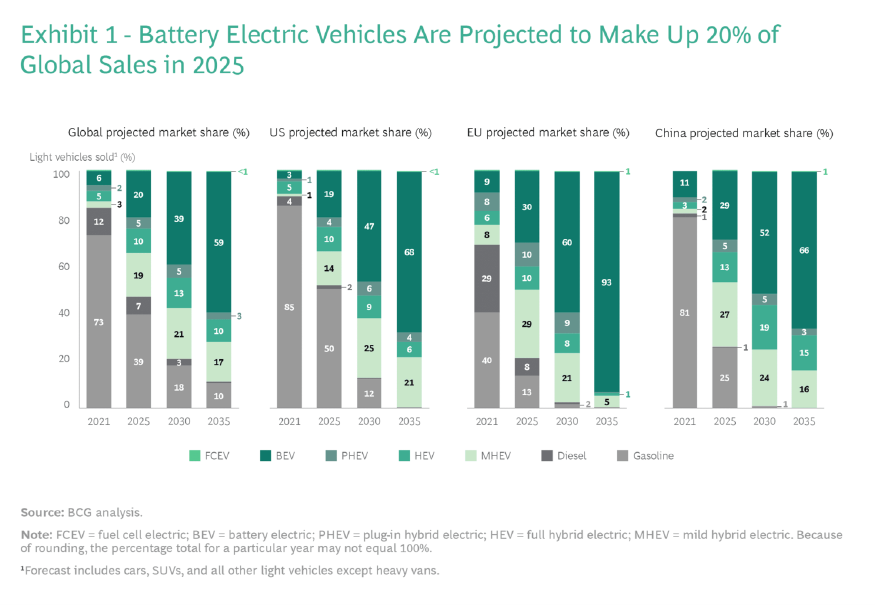
The past year has been phenomenal for electric vehicles, including hybrids. These vehicles accounted for 20% of all light-vehicle production in 2021, up from 12% the previous year, even as volumes recovered from the COVID-19 pandemic. By contrast, the share of gasoline and diesel cars dipped 9 percentage points.

The regulatory pressures curbing the use of fossil-fuel-powered vehicles have increased in major Western markets. In the US, the Biden administration significantly tightened rules on tailpipe emissions. EU legislators drafted policies to reduce the average emissions of all cars in operation by 55% by 2030 (from 2021 levels). More importantly, by stipulating that emissions from new vehicles sold should be decreased to zero five years later, they set an end date for the ICE age in Europe. In both regions, governments have extended incentives encouraging consumers to switch to low-emission vehicles.

Automakers have thrown their support behind EVs like never before. Toyota and Volkswagen, the two largest automakers by sales today, have committed a combined $250 billion by 2030 to EV and battery programs.

Falling ownership costs and incentives have helped drive consumer demand for EVs. The five-year total cost of ownership (TCO) for a midsize car is now the same for both BEV and ICE versions in China and many European countries.

The continuing decline in battery prices, which make up 30% to 40% of an EV’s cost of goods sold, is one factor leading to lower ownership costs. But so too are greater economies of scale due to increased production of EVs.

     An Industry in Transition

The future of the automotive industry is electric. Researchers now expect BEVs to account for 20% of global light-vehicle sales in 2025 and 59% in 2035.

At the same time, the authors stress that the shift toward EVs is causing incumbent automakers to reconsider not just the transition from ICE power trains to electric ones but their entire business models. These companies are executing vertical-integration moves that improve access to battery cells, secure first rights to next-generation battery technologies, and drive higher performance of electric motors.

Automakers are also adopting simplified electronics architectures and a more software-driven approach to drive down costs, unlock new revenue streams, and offset lower near-term margins on EV sales. Through over-the-air updates (the wireless delivery of new software and capabilities), for example, manufacturers can remotely extend the range of EV batteries or enable EV owners to automatically pay for charging infrastructure through vehicle recognition technology. All told, savvy automakers—both incumbent and new age—are recognizing that the shift to EVs significantly boosts the size of the profit pools available to the automotive industry.

     Improved Progress on Climate Goals

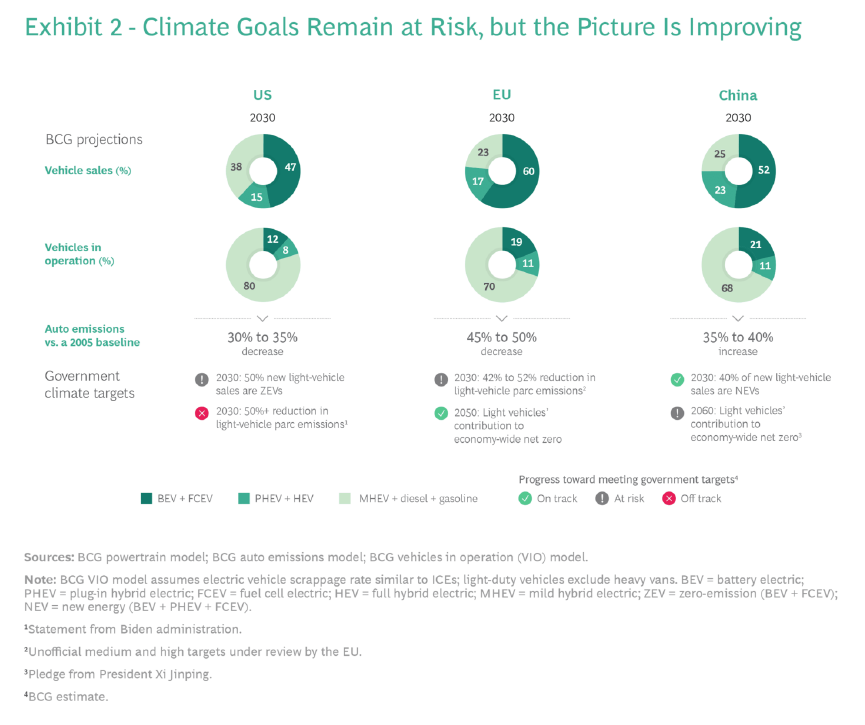
The study point out that by preparing to stop the sale of new fossil-fuel cars from 2035 (the ban should become legally binding next year or in 2024), the European Union is on track to achieve its goal of net-zero CO2 emissions in its “car parc”—the total stock of vehicles in use—by 2050, provided the bloc also continues to invest in mass-transit systems and clean-mobility options such as e-bikes. By then, almost all vehicles on European roads should be zero emission.

Given that EVs accounted for more than 20% of new light-vehicle sales in China earlier this year, we now expect that country to meet its 2030 target for 40% of vehicles sold to be pure electric. All new light-vehicle sales in China will need to be EVs by 2040 for the nation to achieve its 2060 net-zero goal.

The US will need to ban sales of new vehicles other than zero-emission ones by 2035—just as Europe is doing—to fulfill its 2050 net-zero pledge.

It’s not just vehicles that will generate zero emissions because of electrification. The entire automotive value chain is moving toward decarbonization.

Some Remaining Risks to EV Adoption

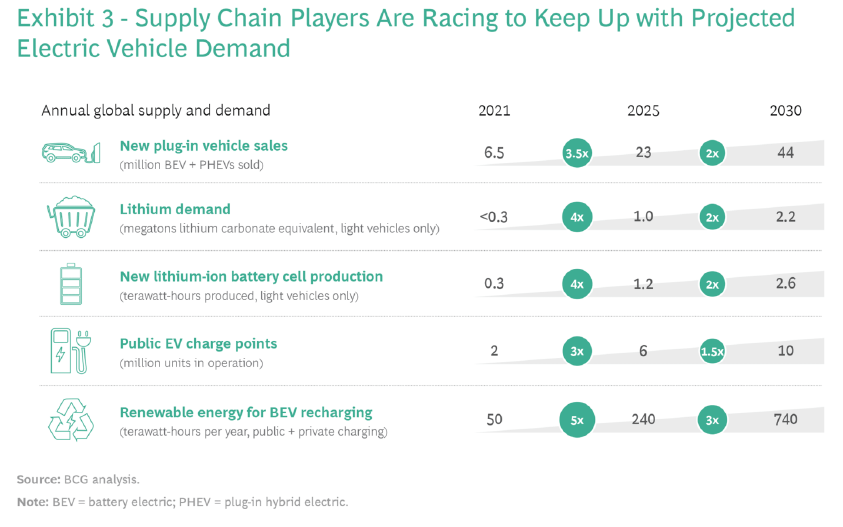
Although the transition to electrified mobility is quickly gathering momentum, the research has identified two short-term supply risks that could limit the rate of industry change—or spur greater innovation as players seek to overcome these obstacles. First, a supply shortage has emerged during the past half year in the metals needed to make EV batteries, including lithium and nickel. Second, insufficient charging infrastructure over the next few years could cause EV adoption to stall in leading markets.

Demand for lithium, for example, is expected to shoot up by a CAGR of more than 25% from now until 2030. But post pandemic supply chain constraints, rising energy costs, and accelerated EV growth have already increased the price of the lithium compounds used for battery production—and are set to push up average battery costs after years of steady declines. Meanwhile, war and economic sanctions have raised nickel prices and threaten to exacerbate shortages of the metal.

A shortage of charging points in some countries looks set to worsen in the near future. In the UK, the automotive industry organization recently highlighted that current EV sales far outpace the growth in public charging stations.

Concern about a lack of public charging sites is already the leading reason for US consumers to think twice about buying an EV, according to a recent survey from Consumer Reports, a nonprofit consumer organization.

     A New Game

Coordinated action will be essential to overcome the challenges we have outlined. Fortunately, there is reason for optimism that players across the automotive ecosystem are prepared to work together, instead of treating the development of viable solutions as a zero-sum game of winners and losers.

In the charging space, a raft of players are helping to accelerate the rollout of publicly available chargers. Governments are freeing up land and supporting ambitious projects such as wireless EV charging. Manufacturers are creating prefabricated charging sites to shorten installation times.

Through innovation, automakers are also taking EV battery recharging to the next level. They are developing new battery-swapping and battery-as-a service models, options that are already popular among drivers of electric two- and three-wheel vehicles. For example, China’s Nio offers customers a subscription-based service enabling them to exchange used batteries for new ones at one of its battery swap stations.

To improve supply chain resilience, automotive manufacturers and battery makers as well as cathode suppliers are forming joint ventures and investing in mines.

The authors conclude that what these actions show is that—when confronted with significant challenges— the automotive industry is quick to innovate. The proof: leading automakers today are still delighting customers and creating value for shareholders. But they are also setting an example for other sectors on how to respond to the climate change challenge.

CEMP – Connected Electric Modular Powertrain (ITA)

L’innovazione sostenibile per la mobilità urbana leggera

CEMP è un progetto di propulsione elettrica “intelligente” destinato ai veicoli leggeri, che punta alla sostenibilità energetica, ambientale e sociale. Il progetto CEMP comprende tre sistemi interagenti fra loro: la propulsione elettrica, l’unità telematica e il sistema di assistenza alla guida, il cosiddetto ARAS (Advanced Rider Assistance System). La sinergia tra la propulsione elettrica, la connettività ed i sistemi di assistenza alla guida consente non solo di eliminare le emissioni allo scarico, ma anche di snellire il traffico e prevenire gli incidenti.

Il progetto si rivolge ai veicoli leggeri di categoria L: scooter, motoleggere, tre ruote e microvetture, veicoli che per loro natura rispondono alla domanda di mobilità individuale e di trasporto nei centri urbani. CEMP è un progetto di innovazione responsabile, perché riunisce le esigenze di tutela dell’ambiente, salute e sicurezza dei cittadini, con il raggiungimento di positivi risultati industriali e che guarda alla sostenibilità complessiva del veicolo efficientando la componentistica attraverso l’integrazione di diverse tecnologie.

CEMP è stato sviluppato nell’ambito del bando Call Hub di Regione Lombardia, co-finanziato dall’Unione Europea. Il partenariato di ricerca formato dal capofila Dell’Orto con OCTO Telematics, Università di Modena e Reggio Emilia ed Energica Motor Company è partito 3 anni or sono, con l’obiettivo di arrivare al veicolo dimostratore esposto in anteprima mondiale a EICMA 2022.


Azzeramento delle emissioni

Il sistema di propulsione elettrica di CEMP è caratterizzato da una architettura in bassa tensione a 48V nominali, con raffreddamento ad aria. Grazie a queste due soluzioni si è semplificata notevolmente l’integrazione nel veicolo, grazie agli ingombri e pesi contenuti ed all’assenza di circuiti e radiatori per il refrigerante. La limitata energia richiesta permette di avere batterie leggere e compatte e quindi, asportabili, consentendo la ricarica delle stesse tramite una normale presa domestica, senza la necessità di particolari infrastrutture di ricarica. Grazie alla propulsione elettrica si annullano le emissioni di inquinanti gassosi, di anidride carbonica e di particolato dallo scarico, e si abbattono le emissioni sonore. L’efficienza energetica non solo è migliore rispetto ad un’autovettura a benzina, ma anche nei confronti delle automobili elettriche.


Snellimento del traffico

Il progetto CEMP rilancia la piccola mobilità urbana, superando tutti i limiti dei tradizionali cinquantini e centoventicinque, e conservando tutte le caratteristiche di compattezza che consentono di decongestionare il traffico e favorire il parcheggio. Inoltre, le caratteristiche di erogazione del propulsore elettrico sono state sviluppate per avere uno spunto da fermo più brillante rispetto ai veicoli della stessa cilindrata, favorendo la scorrevolezza del traffico e un più sicuro disimpegno degli incroci. Un importante contributo allo snellimento del traffico viene dalla connettività del veicolo, che consentirà l’implementazione di modelli di mobilità digitale, in grado di agevolare gli spostamenti in ambito urbano, anche nella prospettiva della “smart city”. La connettività si presta molto bene per i veicoli elettrici, perché consente una più facile gestione del veicolo, con funzioni come lo sblocco del mezzo tramite smartphone, il monitoraggio dello stato delle batterie, la geolocalizzazione dei veicoli, la gestione di flotte di sharing e apre verso l’integrazione funzionale con soluzioni di MaaS.


Riduzione degli incidenti

Il sistema ARAS di CEMP comprende le funzionalità di forward collision warning, blind spot detection e speed limit awareness). I sistemi di assistenza alla guida avanzati possono efficacemente ridurre il rischio di incidenti, tema prioritario se si considera che i motoveicoli a due ruote leggeri sono accessibili sia ad utenti con patente B automobilistica sia a minorenni con patenti AM e A1. Il veicolo è in grado di riconoscere lo scenario in cui si trova e capire se sta per avvenire un impatto con un veicolo, un pedone, una bicicletta ecc. e conseguentemente lanciare un messaggio di allarme al guidatore che in questo modo sarà in grado di avere la possibilità di frenare nei tempi corretti. C’è inoltre l’opportunità di rilevare oggetti nei i punti ciechi degli specchietti retrovisori, avvisando il conducente. È previsto anche un sistema che rileva il superamento dei limiti di velocità ed allerta il conducente, come già previsto dalle recenti normative europee per i veicoli di categoria XX. Non ultimo, grazie alla connettività, in caso di necessità, il sistema potrà effettuare una chiamata per la gestione dell’emergenza (private e-call/Bcall).


Il nuovo ecosistema per la mobilità urbana leggera

Il progetto CEMP si propone come una soluzione globale, dove i componenti del sistema abilitano nativamente i servizi di smart mobility, che potranno svilupparsi secondo un modello di collaborazione aperto grazie alla collaborazione di OCTO Telematics, leader delle soluzioni di telematica a livello internazionale e promotore di un ecosistema allargato grazie all’iniziativa “la via italiana della mobilità connessa”. CEMP non si rivolge soltanto ai costruttori di motoveicoli, ma anche a tutti gli interlocutori pubblici e privati come, ad esempio, le amministrazioni locali, i gestori delle infrastrutture stradali, le assicurazioni e i gestori delle flotte di sharing e delivery. Il progetto è interamente Made in Italy, e questo consente di sviluppare e conservare sul territorio il know-how, l’occupazione e la catena del valore, come testimonia il veicolo dimostratore Piega EV, che è stato realizzato in collaborazione con Mondial, storico marchio lombardo. Il capofila del progetto Dell’Orto costituisce un centro di competenza locale radicato nel tessuto imprenditoriale lombardo da quasi novant’anni. Allo stesso tempo, grazie al respiro internazionale del gruppo Dell’Orto, le soluzioni di CEMP potranno essere proposte e prodotte anche al di fuori dall’Europa, per soddisfare la crescente richiesta di mobilità sostenibile nelle megalopoli del futuro.

In uno scenario che negli ultimi tre anni è radicalmente cambiato, il partenariato CEMP ha saputo tenere lo sguardo orientato al futuro, adattandosi in modo agile al nuovo contesto che richiede, oggi più che mai, soluzioni sostenibili per la mobilità individuale nelle città: sostenibilità energetica, ambientale e sociale, con l’obiettivo di consentire ad ognuno di muoversi liberamente in modo facile, pulito, sicuro.


Dell’Orto S.p.A.

DELLORTO negli anni ha investito nella ricerca ed ha saputo intercettare e guidare le richieste del mercato. Partendo dai carburatori per moto, ha ampliato poi la propria gamma di prodotti studiando e realizzando corpi farfallati, sistemi a iniezione e centraline elettroniche, fino agli innovativi progetti sull’elettrificazione. 

È oggi un’azienda totalmente integrata a livello produttivo che è stata in grado di affermarsi a livello nazionale ed internazionale grazie ai grandi valori che da sempre ne hanno animato e contraddistinto la storia, oltre agli alti livelli di professionalità ed expertise che le hanno permesso di affermarsi nel mondo delle due e quattro ruote con i propri prodotti, il know-how e le relazioni instaurate in quasi novant’anni di ininterrotta attività di ricerca, produzione e distribuzione di sistemi di alimentazione automotive.


OCTO Telematics

OCTO è da sempre fortemente connotata dalla capacità di innovare nel settore della mobilità connessa. Pioniere della telematica per il settore assicurativo, OCTO è oggi il principale fornitore di servizi di telematica avanzata e di soluzioni tecnologiche – oltre che per il settore assicurativo, per il Fleet Management e per la Smart Mobility – ad utilizzare il Machine Learning e l’Intelligenza Artificiale per trasformare i dati in soluzioni pratiche e intelligenti.

Le molteplici applicazioni business e i numerosi casi d’uso consentono a OCTO di portare la telematica al cuore delle smart city e di aprire a una nuova era di telematica intelligente allineata con gli obiettivi globali di sostenibilità espressi nella Vision Zero dell’azienda: zero incidenti, zero traffico, zero inquinamento.

OCTO conta attualmente 5.5 milioni di utenti connessi e detiene il più grande database globale di dati telematici, con oltre 510 miliardi di km di guida raccolti e 501.000 sinistri ed eventi assicurativi analizzati con una capacità operativa di gestione di oltre 400.000 noleggi di veicoli al mese.


UNIMORE

UNIMORE, è attore di eccellenza nella ricerca, nella didattica e nella terza missione per il settore automotive a tutti i livelli, dalla formazione accademica nel Corso di Laurea Magistrale in Ingegneria del Veicolo, Ingegneria informatica e attraverso i due master universitari in Ingegneria del veicolo e in Fluid Power oltre alle due accademy Automotive Accademy (MUNER) in collaborazione con i principali OEM/TIER1 italiani ADBot con Università di Trento oltre alla Cyber accademy, fino a numerosi progetti e contratti di ricerca in collaborazione con le principali aziende della Motor Valley, che cofinanziano da anni borse di Dottorato, Dottorati Industriali, assegni e laboratori. Partner industriali come Ferrari, Alfa Romeo e Maserati collaborano da anni alla definizione degli obiettivi formativi accademici, attraverso la partecipazione ai comitati di indirizzo, e sono coautori oltre che destinatari del trasferimento di competenze di eccellenza fra ricerca e mondo industriale. Il programma TACC e i numerosi spin off, di recente istituzione o già traslati a pieno nella realtà industriale, rappresentano la declinazione di specifiche esperienze di ricerca in prodotti e servizi di avanguardia nel settore automotive, completando un quadro di forte sinergia. Il Dipartimenti di Scienze Fisiche Informatiche e Matematiche attualmente è partner in diversi progetti europei finanziati attraverso il programma quadro Horizon 2020, ed è attivo in molteplici progetti di trasferimento tecnologico verso aziende regionali, nazionali e internazionali leader nei settori dell’automotive, dell’automazione industriale e dei sistemi embedded ad alte prestazioni. È stato capace negli ultimi anni di conseguire importanti contratti di ricerca con i più importanti costruttori di HW (NVIDIA, XILINX) specifici per applicazioni di autonomous driving. Il gruppo rappresenta uno dei punti di riferimento internazionali nella realizzazione di sistemi real-time su piattaforme embedded di prossima generazione, dove coniugare la richiesta di alte prestazioni computazionali con stringenti vincoli di tempo reale, attraverso l’implementazione di sistemi operativi e hipervisor multi-OS che gestiscano il funzionamento di architetture multi-/many-core eterogenee. Il laboratorio è a capo dello sviluppo di un’architettura distribuita per il real-time monitoring di una vasta area urbana -Modena Automotive Smart Area (MASA)-, e prevede l’installazione di un elevato numero di telecamere intelligenti i cui dati vengono elaborati attraverso un paradigma di real-time fog computing. Da ultimo ha sviluppato uno stack di guida autonoma con localizzazione in ambiente non strutturato.

ENERGICA MOTOR COMPANY S.P.A.

Energica Motor Company S.p.A. è la prima azienda italiana di moto elettriche ad elevate prestazioni, nata come progetto nel 2009 dall’esperienza del Gruppo CRP. La factory Energica di circa 3.000 mq, sita nella provincia di Modena, il cuore della Motor Valley Italiana, è il quartier generale e base per la distribuzione delle due ruote Energica verso la rete internazionale di importatori e concessionari. Oggi Energica conta oltre 60 professionisti interni tra progettisti, ingegneri, sviluppatori, meccanici e commerciali.

Quotata nel segmento AIM Italia di Borsa Italiana, Energica è stata designata Costruttore Unico FIM Enel MotoE™ World Cup per i primi 3 anni della competizione, quarta categoria dedicata alle moto elettriche del mondiale MotoGP. Attualmente nella gamma Energica sono presenti 3 modelli, in commercio presso la rete internazionale di importatori e concessionari autorizzati. Grazie a MotoE™ Energica detiene un elemento di competitività senza precedenti che ha permesso di poter introdurre features innovative sui model year 2020. Con il 60% di autonomia in più, coppia incrementata del 10% e il 5% di peso in meno, la gamma Energica 2020 si pone sul mercato come un prodotto unico in termini di tecnologia e performance.

Nel 2019 l’azienda collabora con Dell’Orto per la realizzazione e commercializzazione di una nuova Power Unit destinata a moto elettriche di piccole e medie dimensioni.


Ufficio Stampa OCTO Telematics

Adriana Zambon – press@octotelematics.com

Ufficio Stampa Dell’Orto S.p.A.

Simona Ravasi – simona.ravasi@dellorto.it


.


Sharing Mobility in Italy

by Francesco Lacidogna 

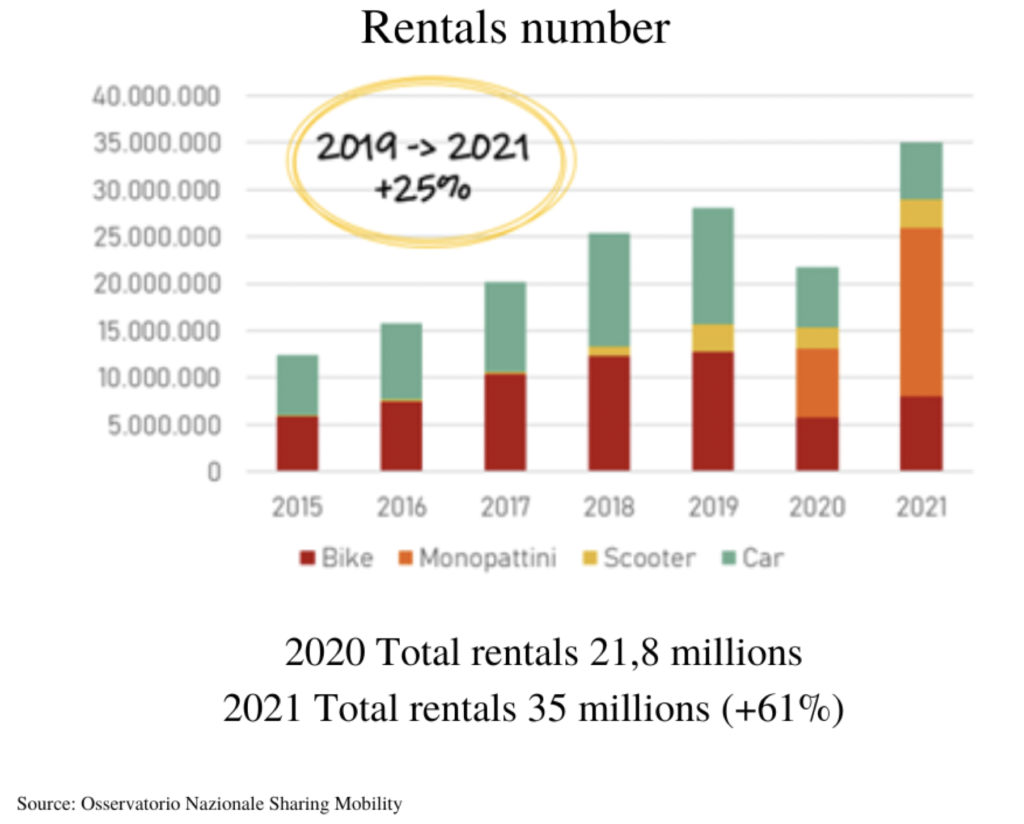
According to the 6th National Report on sharing mobility, in Italy vehicle sharing services grow in 2021 compared to the previous year in terms of rentals and registrations, respectively + 61% and + 31%.

The number of rentals made in sharing mobility is back in line with the trend recorded until the pandemic, a year compared to which the number of rentals in 2021 is 25% higher. On these numbers, the spread and growth of shared scooter services plays a decisive role.

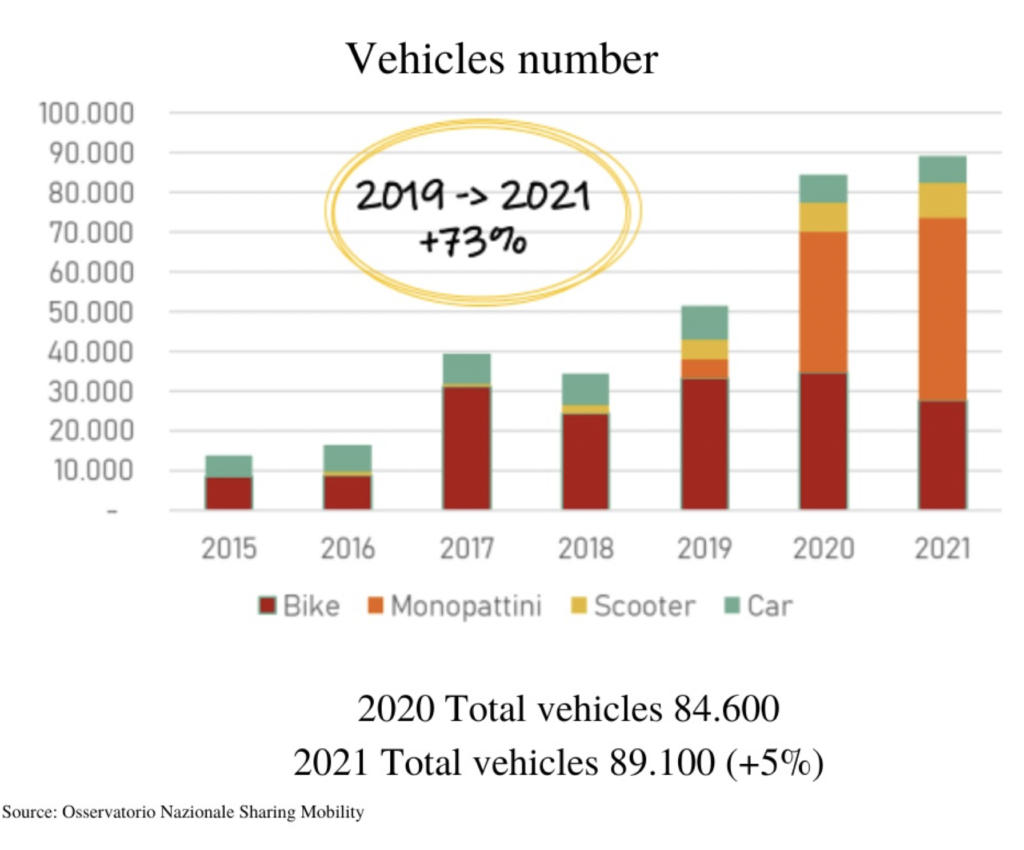
The sharing mobility fleet increased from 84,6 thousand vehicles in 2020 to 89 thousand vehicles in 2021. At the same time, the number of services increased from 158 to 190 in the last year. 52% of the shared fleet is made up of scooters in 2021, 31% of bicycles, 10% of mopeds and 7% of cars. The figure for zero-emission vehicles in the fleet also increased, the share of which rose from 92% to 94.5% in the last year.

CAR SHARING

In 2021, free-floating car sharing records 8% fewer rentals than in 2020, but increases the duration of rentals to 43,7 minutes, about 11 minutes higher than in 2019. Station based Car sharing services are better with + 22.2% of rentals compared to 2020.

32% of cars are electric or hybrid and electric has increased by 12% compared to 2020.

BIKE SHARING

Bikesharing, both in free-floating and station-based operating models, rebounds compared to 2020, registering a + 56% with 4,6 million rentals and + 22% with 3,4 million rentals. The performance of 2019 remains still 37% lower for free-floating services and 36% for station-based services.

MONOPATTINI (SCOOTERS)- SHARING

2021 certifies the strong diffusion of scooter-sharing services, a segment of sharing mobility that alone recorded half of the total rentals made in Italy (17,9 million), more than doubling the previous year’s performance. Registrations for services also increased at the same pace, which in December 2021 are estimated at around 2,7 million (+144% compared to the previous year).

SCOOTER SHARING

The use of shared scooters is also expanding strongly, which in 2021 returned to the demand levels of 2019 (+ 5%). Total trips made on a shared moped were 3 million in 2021, + 40% compared to the previous year. The increase in subscriptions to services was also similar, for a total of 807.000

Fleet Europe Summit 2022

OCTO will participate in the “Fleet Europe Summit” which takes place in Dublin, from 16 to 17 November 2022.

The Fleet Europe Summit is the leading international conference for all Fleet and Mobility Leaders. This 2-day event is the best place to stay on top of the latest transformations to our industry, including innovations in Mobility as a Service, Connectivity, Electrification, Vehicle Financing, Car Remarketing and new technologies in safety, last mile delivery, ADAS and autonomous vehicles.


OCTO will be attending the Fleet Europe Summit, don’t miss the opportunity to connect with us!

Become
a Contributor!
We’re always looking for interesting ideas and content to share within our community.
Get in touch and send your proposal to: press@octotelematics.com